
- وشاح حريري مخصص
- ربطة عنق مخصصة
- ربطة عنق عنق العنق المخصّصة
- Custom Print Fabrics
- Printed Satin Silk Fabric
- Printed Twill Silk Fabric
- Printed Silk Crepe De Chine Fabric
- Printed Silk Georgette Fabric
- Printed Silk Habotai Fabric
- Printed Silk Jacquard Fabric
- Printed Silk Cotton Fabric
- Printed Silk Viscose Fabric
- Printed Silk Linen Fabric
- Printed Silk Tencel Fabric
- Printed Silk Modal Fabric
- Printed Silk Wool Fabric



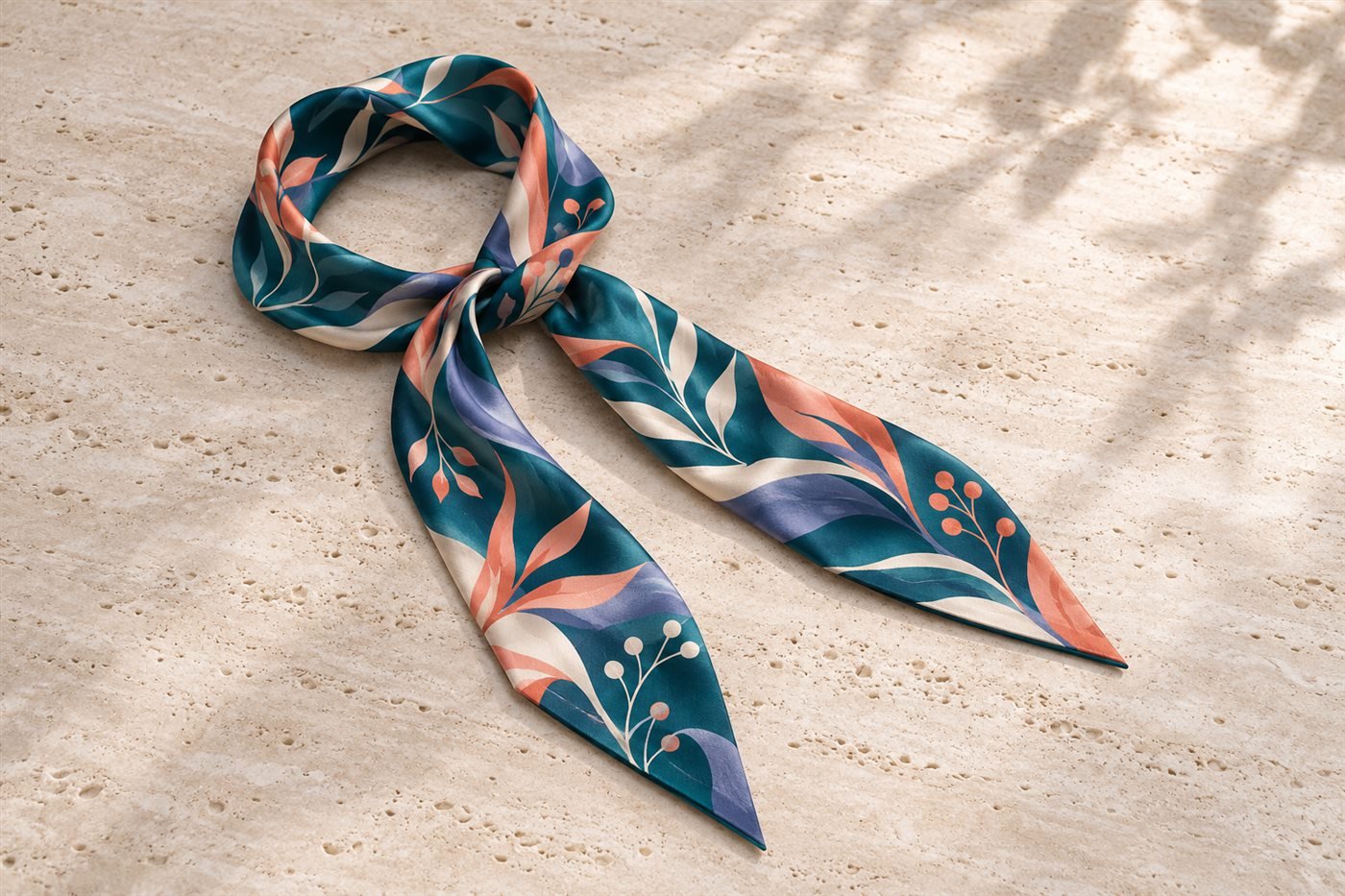
A custom silk twilly is a small-format accessory with unusually high demands on design placement. On a square scarf, a motif has room to breathe. On a narrow strip, a few millimeters of finished width, a shifted repeat or a crowded tip can change what buyers actually see after tying. That is why a twilly brief should describe the intended use and finished construction before anyone approves the artwork.
This guide is for fashion brands, museum shops, beauty companies and corporate buyers planning a narrow silk scarf collection. It focuses on the decisions that make a sample useful: proportion, artwork, print visibility, ends, labels and wear testing. For a comparison of square, long and narrow formats, start with our custom silk scarf size guide.
Start with the finished use, not a generic template
“Twilly” can describe several long, narrow scarf proportions. A piece intended to wrap a bag handle needs a different balance of length, flexibility and visible pattern from one intended as a short neck tie or hair accessory. Instead of accepting a nominal size alone, ask for the finished width and length, the shape of both ends, and a photo or physical reference showing how the piece will be worn.
Try the proposed length on the actual handle, neckline or hairstyle in your merchandising plan. If the ends are meant to hang visibly, check how much patterned area remains after the knot. If the strip will wrap around a handle, check the pattern at successive turns rather than only on a flat artwork file. The product specification should follow this use test.
Three practical usage questions
- Will customers mostly tie it around the neck, hair, wrist or a bag handle?
- Should a logo, border or end motif remain visible after the common tie?
- Will the product be sold on its own, attached to another item, or presented as part of a gift set?
These answers help the supplier propose a sample, but they do not replace an approved finished measurement. For broader material, printing and finishing choices, see CarinaSilk’s custom silk scarf service.
Design for the visible strip
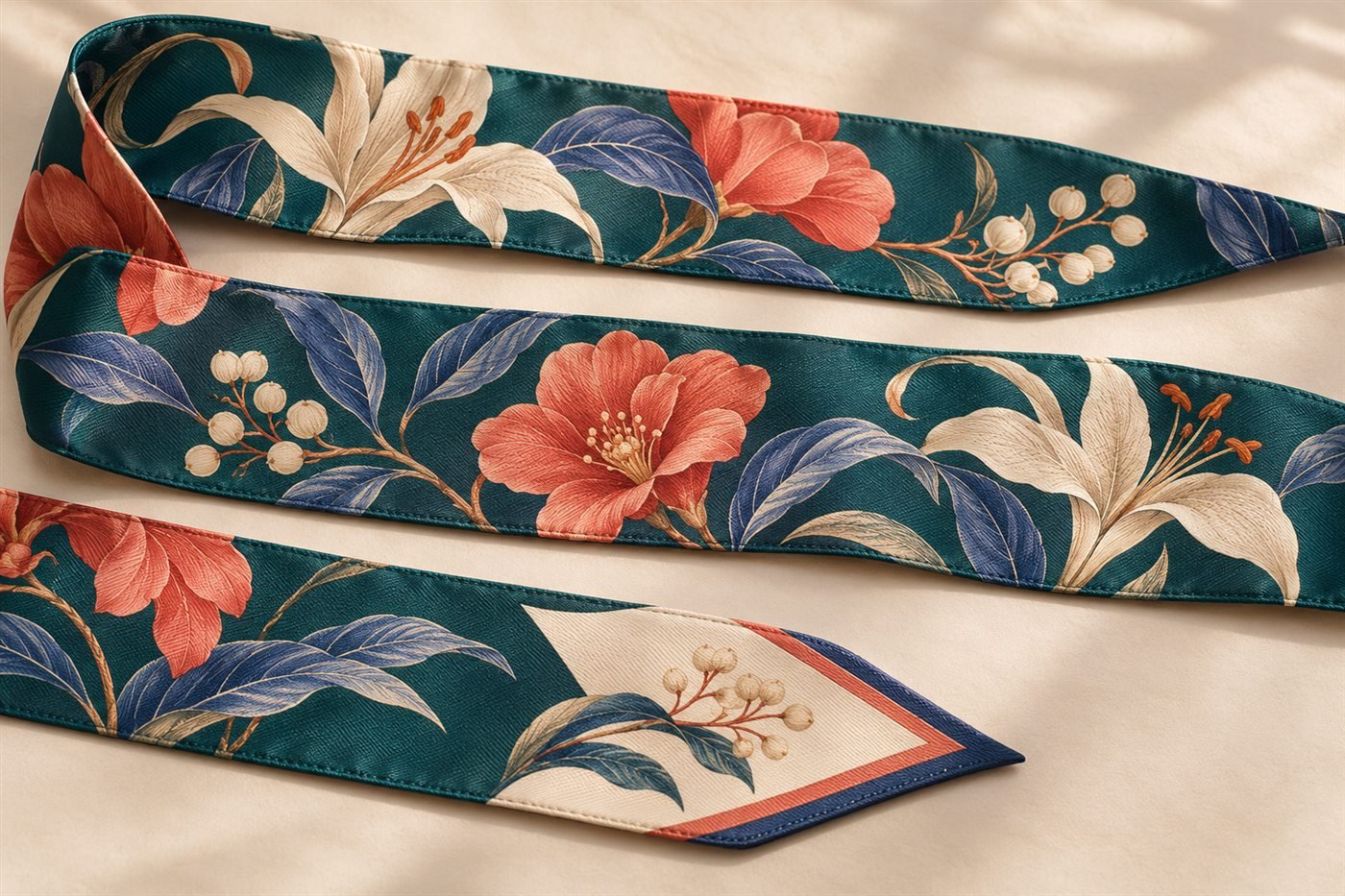
A narrow format should not simply be cropped from a square scarf print. Borders, large illustrations and logos that work on a broad field may become fragmented or disappear when the strip is folded or wrapped. Build the design around the visible center, then review its behavior at the edges and tips. The key question is not “Does the flat file look attractive?” but “Does the print still read when the customer uses the scarf?”
Small-scale repeats, stripes and directional sequences can be effective starting points because they keep visual interest across different folds. A large single motif can also work, but its most important portion should be placed where it will remain visible in the intended tie. Before finalizing, print a paper strip at finished size and test several folds. This simple mock-up will not predict silk drape or color, yet it can reveal poor motif placement early.
Plan the middle and the ends separately
The central length may be mostly hidden in a knot or wrapped around an object, while the last section remains on show. Give the supplier one marked artwork layout that identifies the center repeat, both end zones, print direction and any intentional asymmetry. If the two ends carry different motifs, label them clearly in the file and proof. Ask where the cut and seam lines fall before placing fine details near a tip.
Allowing sensible space around important details is useful, but the precise allowance depends on the agreed construction and finishing method. Do not assume a generic bleed or seam margin. Confirm the supplier’s template for your chosen finished dimensions and review the production proof against it.
Choose construction and print appearance together
A twilly may be made with different fabric and construction choices. The buyer should specify the desired hand feel, appearance and use rather than assume that one silk weight or weave is universally best. Compare relevant fabric swatches under ordinary light, then ask for a finished sample when the decision depends on how the narrow strip drapes and ties. A flat swatch cannot show whether a pointed end lies neatly or whether a seam affects the feel of a knot.
Also agree on how the reverse should look. Depending on printing and construction, the back may not have the same color strength or pattern as the face. This matters when the twilly is twisted around a handle or tied with both surfaces visible. If equal-looking faces are essential, say so in the request for quotation and approve that requirement on a physical sample. Do not use “double-sided” without defining the expected result.
Compare options on the same brief
| Decision | What to specify | What to inspect on a sample |
|---|---|---|
| Proportion | Finished width, length and tolerance to confirm | Fit on the intended handle, neck or hair style |
| Artwork | Repeat, direction and end-zone placement | Motif visibility after tying or wrapping |
| Ends | Pointed or straight shape and construction | Symmetry, neatness and visual balance |
| Required face and reverse appearance | Color and pattern on both visible surfaces | |
| Branding | Label position and packaging concept | Comfort, readability and presentation |
Use this comparison to make quotations comparable. A price for one fabric, print appearance or end construction should not be treated as equivalent to a different specification. Costs, minimum quantities and timing depend on the actual project.
Keep labels and packaging proportional
A label that is unobtrusive on a square scarf can be distracting on a narrow twilly. Decide whether branding belongs on the textile, a small sewn label, a hangtag or the retail packaging. Then review where the label sits when the scarf is tied. It should not interrupt the most visible motif or create an awkward stiff point. Any required care information and market-specific labeling should be agreed with the supplier and checked against the buyer’s destination market requirements.
Packaging also needs a practical test. A compact card or box may present the scarf elegantly, but it should not create a permanent-looking crease across a featured motif or leave the pointed ends crushed. Check the packed sample after storage and unpacking, not just the empty package design. If the twilly will be part of a larger gift set, confirm how it is secured without snagging or hiding the design.
Approve a sample as a product, not just as a print
A digital proof can confirm artwork placement and text, but it cannot establish silk hand feel, actual color, sewing quality or how the strip behaves in use. Request the sample route that answers your most important open questions. A swatch can narrow fabric choices; a print trial can test color and detail; a finished twilly can test the whole product. These stages are not interchangeable.
Inspect the finished sample laid flat, tied at the neck and wrapped or knotted in its intended use. Take dated approval photos of both faces, both ends, the label and packaging. Record any change requests in writing. If a revision changes size, artwork, fabric or construction, confirm whether a new physical sample is needed before bulk production. CarinaSilk’s ordering guide explains the broader brief and sampling sequence.
Sample approval checklist
- Finished width, length and the shape of both tips match the agreed specification.
- The central repeat and end motifs look balanced when the scarf is flat and tied.
- Colors and fine details are acceptable on the actual selected fabric.
- The expected face and reverse appearance is visible in the intended styling.
- Seams, edges and label placement feel appropriate for the narrow format.
- The packed scarf presents well after it is removed and unfolded.
Frequently asked questions
Can I reuse my square scarf artwork for a twilly?
Possibly, but it should be redesigned or at least re-laid out for the narrow finished area. Test the repeat, motif scale and end placement at actual size before approving a print.
Should a twilly have pointed or straight ends?
Either can suit a collection. Choose based on the intended styling and visual identity, then define the shape precisely in the quotation and inspect a finished sample.
Does a double-layer twilly automatically look printed on both sides?
No. Construction and print appearance are separate specifications. State what the reverse must look like when the piece is twisted or tied, and confirm it on a sample.
What information should I send to request a quote?
Share intended use, estimated finished size, artwork or design direction, preferred silk feel, desired print appearance, end shape, label and packaging needs, quantity by design, and destination. Project-specific details will determine the quotation.
Request a twilly sample or quotation
Send CarinaSilk your intended use, target dimensions and artwork, even if the design is not final. Ask the team to confirm the available fabric, construction and sampling options for that exact brief. Use the contact form to request a custom silk twilly quotation or sample discussion.