
- Foulard en soie personnalisé
- Cravate personnalisée
- Nœud papillon personnalisé
- Custom Print Fabrics
- Printed Satin Silk Fabric
- Printed Twill Silk Fabric
- Printed Silk Crepe De Chine Fabric
- Printed Silk Georgette Fabric
- Printed Silk Habotai Fabric
- Printed Silk Jacquard Fabric
- Printed Silk Cotton Fabric
- Printed Silk Viscose Fabric
- Printed Silk Linen Fabric
- Printed Silk Tencel Fabric
- Printed Silk Modal Fabric
- Printed Silk Wool Fabric


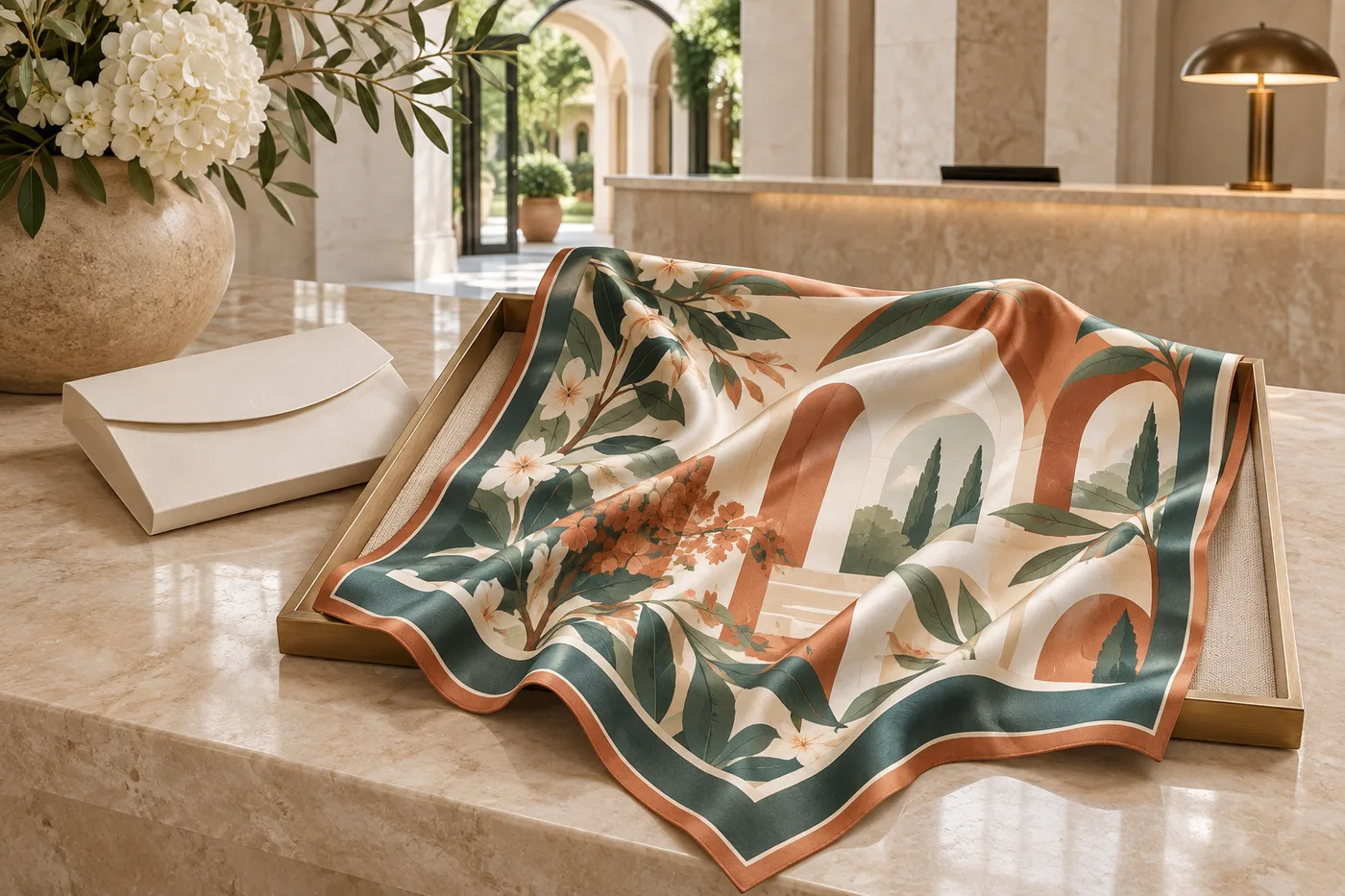
A hotel scarf can do three quite different jobs. On a reception team, it is part of a working uniform. In a guest gift box, it becomes a keepsake. On a boutique shelf, it must stand on its own as a product someone chooses to buy. The artwork may be related, but the purchasing brief should not be identical.
This guide helps hotel and resort buyers plan a custom silk scarf programme around those real uses. It covers format, fabric, design, sampling, packaging and replenishment questions to resolve before approving production. It is a planning framework, not a claim that one specification suits every property.
Hospitality wardrobe design can be part of a property’s visual identity. For example, Hilton’s account of the Waldorf Astoria New York wardrobe project describes design cues drawn from the building and attention to staff comfort. That is useful inspiration for a brief; it is not a CarinaSilk client example or a template to copy.
Start with the scarf’s job, not the artwork
Before asking for fabric swatches, write down where the scarf will appear and who will handle it. A single destination-inspired motif may connect all items, but the production details should follow the use case. A front-desk accessory needs an approved tying method and a practical care plan. A gift needs presentation and recipient information. A retail item needs a selling story, clear size and fabric disclosure, and consistent replenishment.
| Use | Primary buyer question | Sample to approve |
|---|---|---|
| Front-of-house uniform | Does it look consistent and feel comfortable through a shift? | Scarf tied with the actual uniform, including care and wear testing |
| Guest or VIP gift | Does the design feel personal to the property and ready to present? | Finished scarf with final card, label and packing method |
| Hotel boutique | Would a guest choose it without an explanation from staff? | Finished product, display fold, label and shelf presentation |
If the programme spans several departments or properties, decide early whether each needs the same design, a shared palette with distinct motifs, or a small family of coordinated formats. That decision affects sampling and later reorders.
Uniform scarves: test the finished look in motion
A uniform scarf is seen repeatedly at check-in, concierge desks, restaurants and guest events. The best sample is therefore not a flat product photograph. Ask a team member to wear the proposed format with the actual jacket or shirt, then check the knot, visible print, drape and comfort while moving. The design should still read when most of the cloth is folded away.
For a consistent team appearance, document one or two permitted tying styles with simple photos. Consider whether the scarf must work across different necklines and whether a pocket square or tie should share the motif. If several staff members will wear the item daily, ask how cleaning, spare stock and replacement will be managed. Do not assume that a premium gift scarf automatically works as a uniform accessory.
When comparing silk with another fibre, specify the intended cleaning route, desired feel and budget instead of choosing by appearance alone. Confirm fabric composition and care instructions on the approved sample. A property may prefer different materials for daily uniforms and occasional ceremonial wear.
Gift scarves: make the property story wearable
A guest gift often works best when it has a recognizable link to the place without becoming a large advertisement. Possible starting points include architectural details, landscape forms, local flora, a historical colour scheme or an original illustration commissioned by the property. Check that the hotel owns or has permission to use every logo, artwork and photograph supplied for printing.
Think about the recipient and moment of presentation. A compact neck scarf may suit a welcome gesture; a larger square could feel more like a special-occasion gift. Neither is inherently better. The choice depends on recipient mix, intended styling and the cost of the complete pack. If the scarf is part of a tiered VIP programme, decide whether all tiers share one print or whether the higher tier has a distinct colourway or packaging treatment.
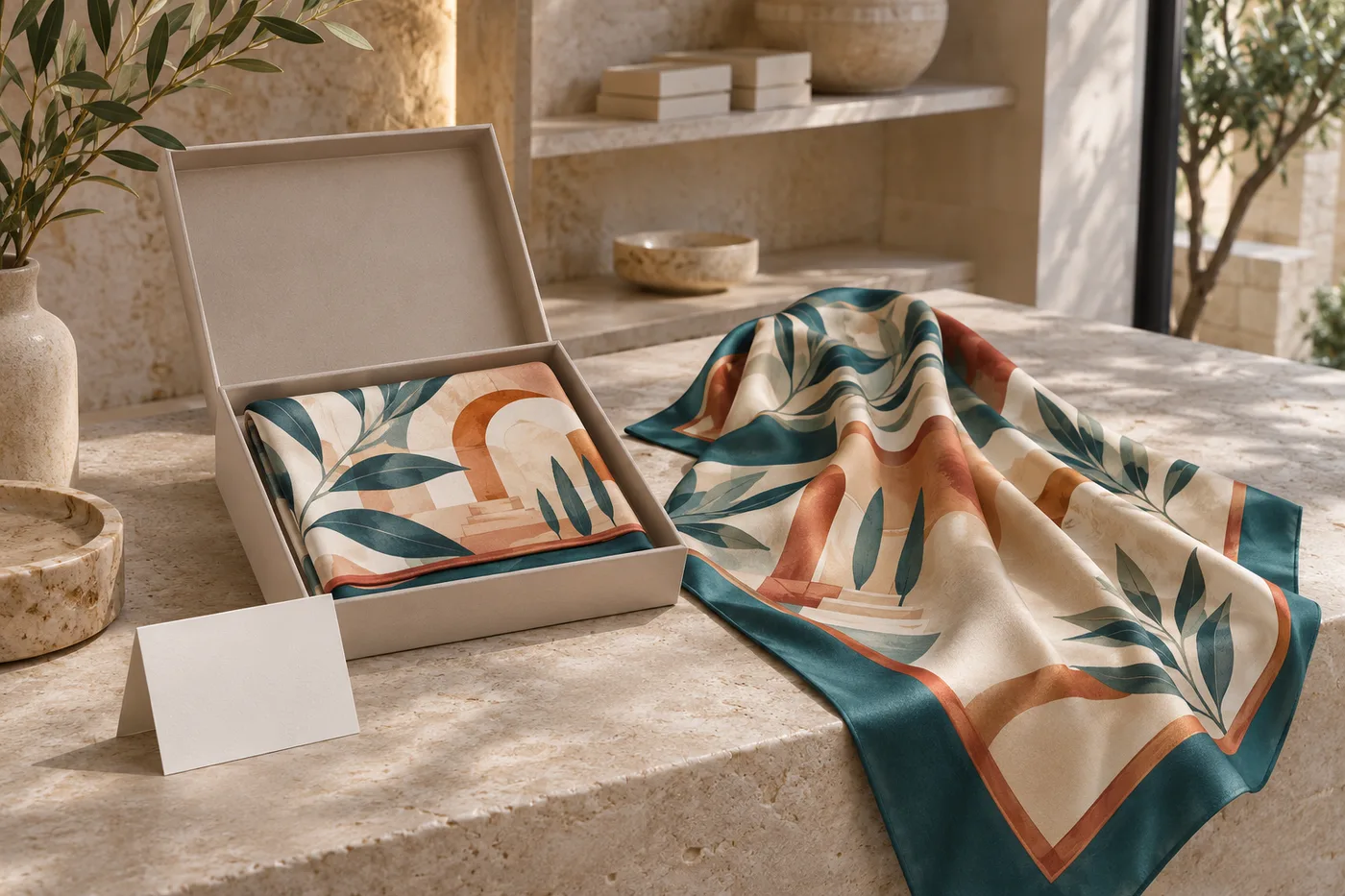
The packaging brief should cover the sleeve or box, any insert card, the care label, and how pieces will be stored before distribution. Request a packed sample, not only a finished scarf. The unboxing experience can fail if the fold hides the motif, the box is too small, or the card text is not approved.
Boutique scarves: design for the shelf and the second purchase
A hotel boutique item must appeal to someone who may not know the property’s design story. Test the scarf at the intended display size. Can a shopper see the main motif when the piece is folded? Does the border work with several styling methods? Is the product name specific enough to distinguish one colourway from another?
Plan how the item will be photographed, tagged and reordered. Keep a record of the approved artwork version, fabric, size, print direction, hem, label and packing components. If a collection sells across multiple properties, give each variation a clear internal identifier. Otherwise, later replenishment can quietly drift away from the original approved sample.
Retail launches also need a practical quantity plan. Rather than assuming a universal minimum order or lead time, ask for a quotation against the exact format, material, print, finish, packaging and delivery destination. Confirm whether the same specification can be repeated in a later run, and what may change if the order size or material changes.
Build one coherent design system
Hotels often have several visual assets: a logo, a property colour palette, interior materials, architectural shapes and photography. A scarf print should translate those cues into something a person would want to wear. Start with one clear idea, then test it in the likely fold and knot positions. A motif that is beautiful at full size can disappear when tied; a dominant logo can be difficult to style.
Protect the artwork and colour decisions
Supply the original editable artwork when available. Mark any colours that are non-negotiable and provide an agreed colour reference or physical sample. Screen and fabric colours will not look identical under every light source, so review a physical printed sample under the lighting in which the piece will be worn or sold. Approve the final scale, border placement and reverse-side appearance rather than only the digital mock-up.
Use a format family carefully
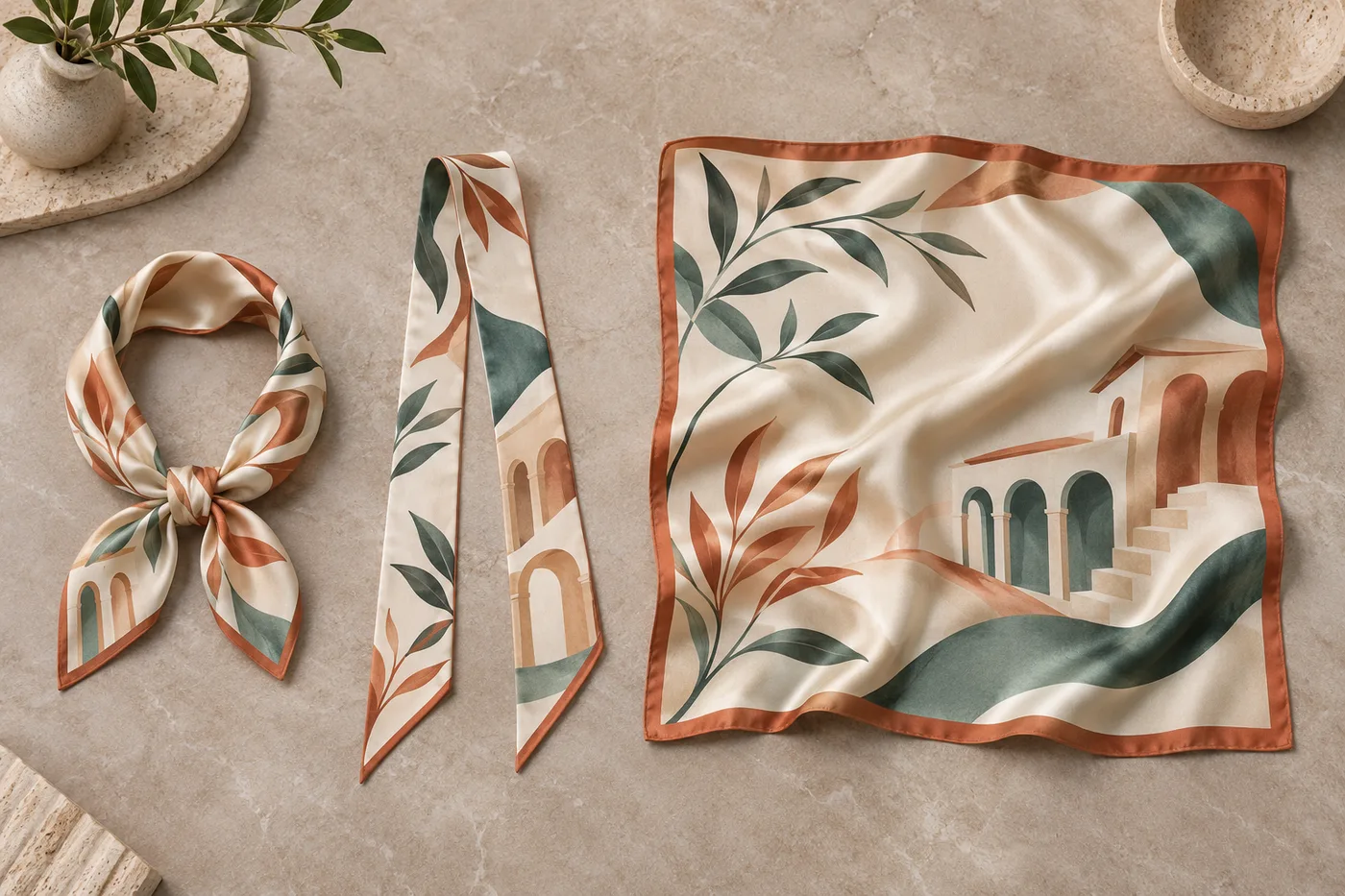
A small neck scarf, narrow twilly and larger square can share a visual language without being simple scaled copies. Small formats may need fewer tiny details and a different logo position. A larger square may benefit from a border that frames the composition. Ask for mock-ups of each actual finished size before deciding that one artwork file can serve every format.
Sampling and approval: what to sign off
Before production, ask for a physical sample or a clearly defined approval route that fits the project. Compare the sample against a written specification, not memory. A useful approval record covers:
- Fabric composition, weight or hand feel, and the chosen finished size.
- Artwork version, print orientation, colour references and appearance on the reverse.
- Hem type, corner finish, label position and visible stitching.
- How the scarf looks tied, folded for display and placed in the final pack.
- Care wording, packing components and any barcode or stock identifier.
- Agreed inspection points, acceptable variation and who gives final approval.
Take photographs of the approved sample in the intended use setting and retain the physical reference when practical. If a new colourway or fabric is added later, do not assume the earlier approval automatically covers it. For a broader production workflow, see CarinaSilk’s how-to-order guide and its pre-shipment quality checklist.
Prepare a useful hotel scarf RFQ
A strong request for quotation lets a manufacturer compare like with like. Share the property or brand context, the three intended uses, artwork rights, target fabric feel, preferred formats, anticipated quantities by variation, packing plan and delivery destination. State which decisions are open for recommendation. If there is a launch date, separate the date you need the sample from the date you need finished goods.
Ask suppliers to identify assumptions in their quotation. A price for an unpacked scarf should not be compared directly with a price that includes a box, card and individual handling. Likewise, a sample quote may use a different approval scope from full production. The exact minimum quantity, production time and cost depend on the final specification and must be confirmed for your project.
Frequently asked questions
Can one design be used for uniforms, gifts and retail?
Yes, a common design system can connect them. However, size, logo placement, fabric and packaging may need separate decisions for each use. Review physical samples in their actual contexts before approving the family.
Which scarf size is best for hotel staff?
There is no universal size. Start with the uniform neckline, permitted knot and desired visible print area. Test at least one finished sample with the actual uniform and get feedback from the people who will wear it.
Should a hotel choose silk for every use?
Not necessarily. Silk can suit premium gifting or retail, but uniform care and replacement needs may lead to a different choice. Specify the use, care route and desired appearance, then compare appropriate swatches and samples.
What should be approved before a boutique launch?
Approve the finished scarf, label, product information, folded display, packaging and a reference specification for reorders. A digital rendering alone will not show every issue with drape, colour and shelf presentation.
How far ahead should a hotel order?
Work backward from the first wear, gift date or shop launch. Allow time for artwork review, material selection, sampling, revisions, production, inspection and delivery. Ask for a project-specific schedule rather than relying on a generic lead-time promise.
Turn your concept into a production brief
CarinaSilk can review a hotel or resort scarf brief and advise on fabric, format, print and presentation options. Explore the custom silk scarf service, then request a quotation or sampling discussion. Include your intended use, design files or reference images, expected quantities by variation, packaging needs and target delivery date so the response can be tailored to your project.