
- Individueller Seidenschal
- Individuelle Krawatte
- Individuelle Fliege
- Custom Print Fabrics
- Printed Satin Silk Fabric
- Printed Twill Silk Fabric
- Printed Silk Crepe De Chine Fabric
- Printed Silk Georgette Fabric
- Printed Silk Habotai Fabric
- Printed Silk Jacquard Fabric
- Printed Silk Cotton Fabric
- Printed Silk Viscose Fabric
- Printed Silk Linen Fabric
- Printed Silk Tencel Fabric
- Printed Silk Modal Fabric
- Printed Silk Wool Fabric



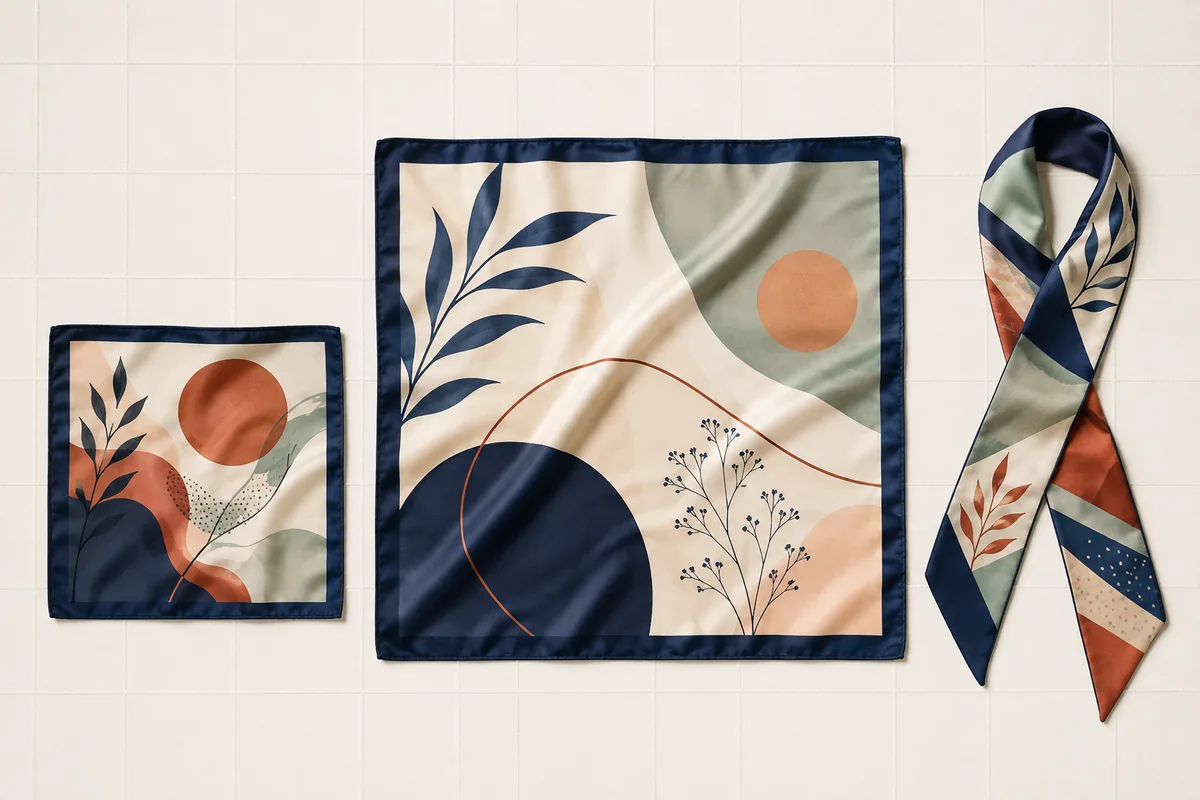
Choosing a custom silk scarf size is not simply a matter of selecting the largest piece that fits the budget. Size changes how a scarf is tied, how much of the artwork is visible when it is folded, how substantial it feels, and how the finished product fits into a collection or gift programme.
This guide gives fashion brands, museums, corporate buyers and private-label teams a practical framework for comparing square scarves, twillies and long scarves before sampling. The dimensions below are useful planning references, not universal production standards. Your final specification should confirm the finished measurement, fabric, edge finish, artwork allowance and acceptable tolerance for the individual project.
Why Scarf Size Changes More Than the Measurement
A design can look balanced as a 90 cm square and crowded when reduced to 45 cm. A narrow scarf can display a repeating border beautifully but hide a large central motif once it is tied. A long scarf creates vertical movement and drape, while a square creates multiple triangular and diagonal views.
Before choosing dimensions, define the job the scarf needs to do:
- Wearability: Will it be tied at the neck, worn in the hair, wrapped over the shoulders or used as a bag accessory?
- Artwork visibility: Must a logo, signature, border or key illustration remain visible after folding?
- Brand position: Is the product a small add-on, a versatile core accessory or a statement piece?
- Presentation: Does the scarf need to fit a particular box, sleeve, retail display or gift set?
- Production brief: Which fabric, printing method and hem will be used, and what is the required finished measurement?
Custom Silk Scarf Sizes at a Glance
| Format | Planning size range | Typical use | Artwork priority |
|---|---|---|---|
| Small square | 35–45 cm | Neck detail, wrist, hair or bag accent | One clear motif, readable border and restrained detail |
| Small-to-medium square | 50–55 cm | Neck scarf, hair accessory or compact gift | Balanced centre-and-border layout |
| Medium square | 65–70 cm | Versatile fashion, museum or corporate scarf | Motifs that work flat and in triangular folds |
| Classic large square | About 90 cm | Neck, head or shoulder styling | Richer composition with strong corners and diagonals |
| Oversized square | 110 cm and above | Statement scarf or light wrap | Larger-scale artwork that remains coherent when draped |
| Twilly or skinny scarf | About 5–8 × 85–120 cm | Bag handle, hair or narrow neck tie | Repeat, stripe or directional sequence |
| Long or oblong scarf | About 30–70 × 160–200 cm | Neck, shoulder or stole styling | Vertical flow, end panels and controlled repeats |
These ranges help organise a design discussion; they should not be copied into a purchase order without confirmation. For market context, the current Hermès scarf 90 is listed at 34.8 × 34.8 inches, while an official Hermès Twilly is listed at 2 × 34.1 inches. The Metropolitan Museum of Art also records a modern silk square at 90 × 90 cm. These are examples of established formats, not requirements for a custom project.
Choose the Shape Before Finalising the Size
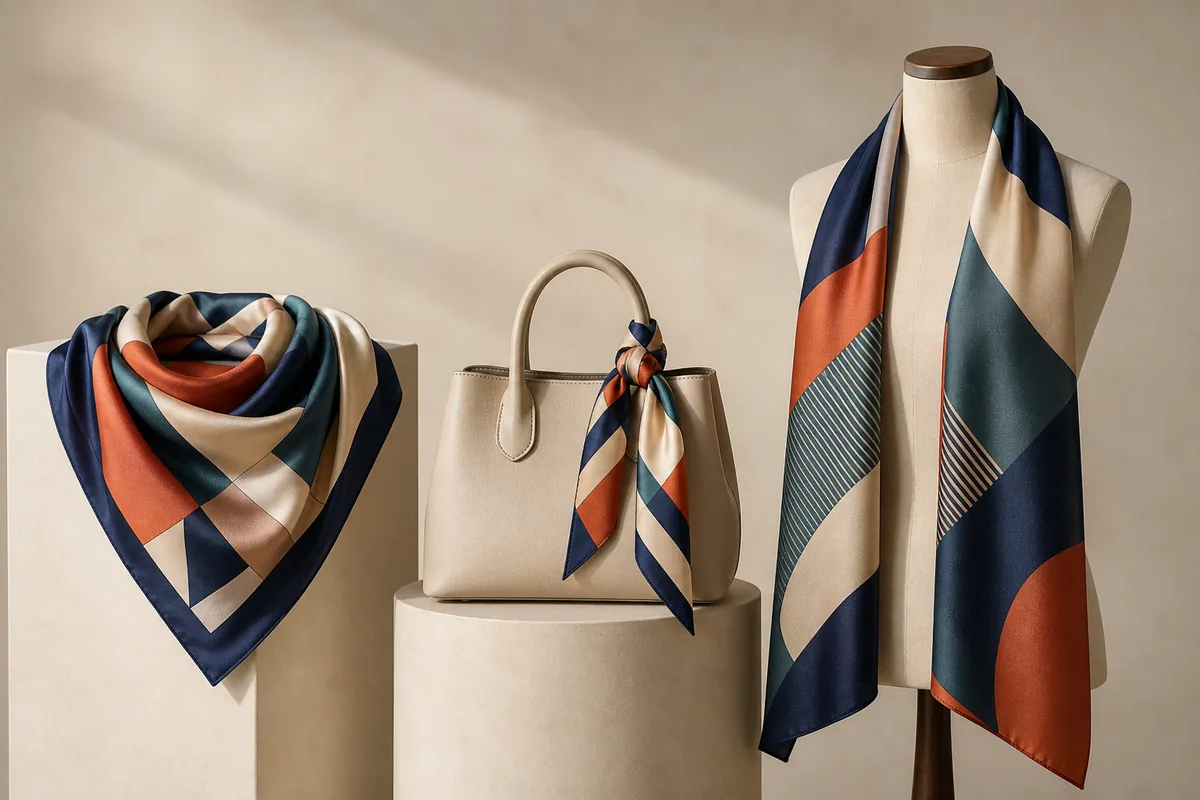
Square scarves
Squares are useful when the artwork has a strong centre, corners or border. They can be folded diagonally into a triangle, rolled into a band or tied to display alternating sections of the design. Small squares reward simplicity. Larger squares give an illustrator more room, but the flat composition still needs to survive folding.
Twillies and skinny scarves
A twilly is a narrow ribbon-like format rather than a reduced square. Long edges dominate the view, and only short sections are visible after knotting. Repeating motifs, stripes, small icons and planned end details usually work better than a single large scene. If a logo must show, place it only after testing realistic tie positions.
Long scarves and stoles
An oblong scarf is naturally suited to directional artwork. The centre may sit behind the neck or across the shoulders, while the ends remain visible. Treat the two ends as deliberate display zones and decide whether they should match, mirror or tell different parts of the story. The Met Store’s current oblong silk examples demonstrate that this category can use substantially different proportions from a square, including 72 × 22 inches.
Custom shapes
Diamonds, triangles and asymmetric formats can support a distinctive collection, but they require earlier agreement on orientation, cutting and edge treatment. Supply a dimensioned outline rather than relying on the artwork canvas alone. Ask how the printed panel will be positioned and cut before approving a sample.
How Artwork Should Change With Scarf Size
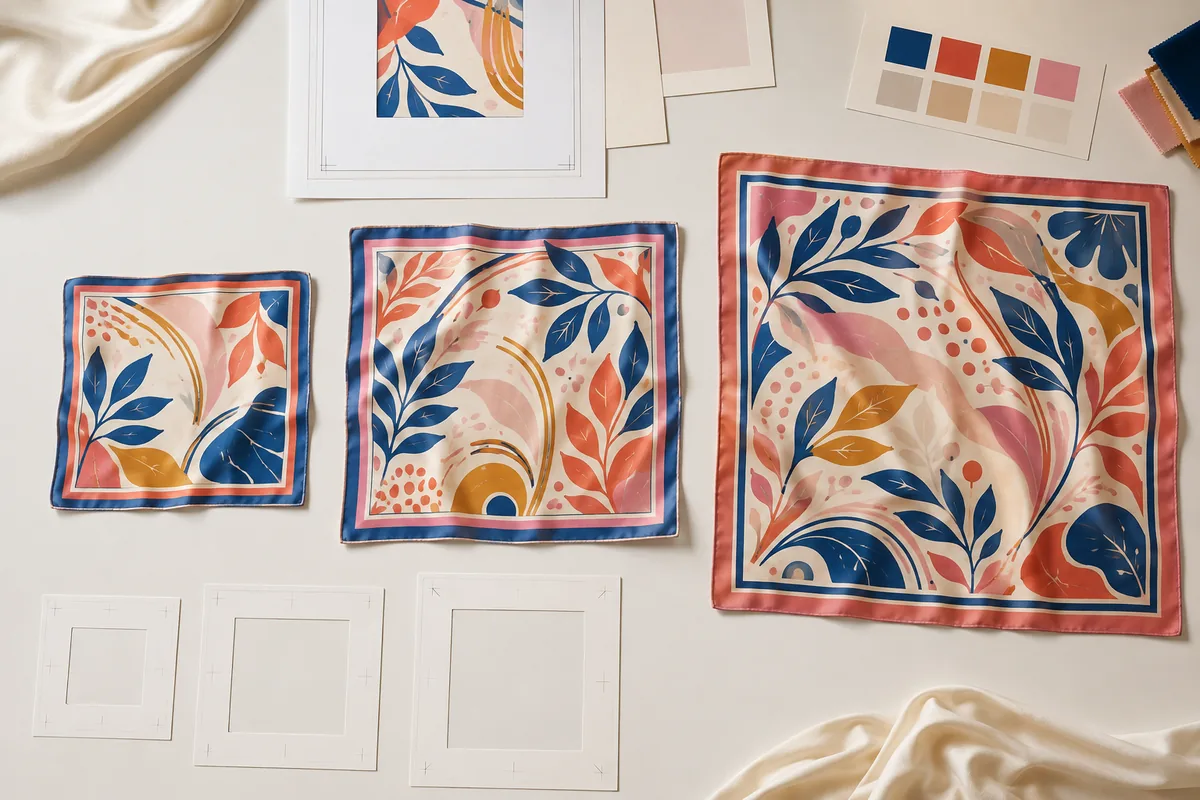
Protect the fold-visible zones
Print the layout at reduced scale and mark common diagonal, band and rolled folds. Check which corners, borders and motifs remain visible. A logo placed precisely in the middle may disappear, while a small signature near a corner may appear repeatedly during styling. Use multiple views rather than judging only the flat square.
Rescale details deliberately
When moving from a large square to a smaller one, do not shrink every line by the same percentage. Thin strokes and small gaps may become visually weak, especially on textured or lightweight fabric. Simplify secondary details, enlarge important motifs and preserve breathing room around the border. For production-ready file preparation, follow the custom silk scarf artwork guide.
Plan the border and bleed together
A border makes cutting and hemming variation more noticeable because the eye compares parallel lines with the finished edge. Confirm the required bleed and safe area after the hem is selected. Keep essential text and marks away from the construction zone, and ask for the actual production template rather than building from a generic online mock-up.
Fabric, Momme and Hem Affect the Finished Result
Two scarves with the same length and width can behave differently. A fabric with more body can hold a sculptural knot, while a lighter fabric may collapse into a smaller visual volume. Surface sheen and transparency also influence whether dense artwork feels rich or overly busy. Compare swatches and drape, not size alone.
The edge finish is part of the dimensional specification. A hand-rolled edge consumes material and can produce small natural variation; Hermès explicitly notes this on its current hand-rolled scarf 90 product page. Machine hems and other constructions have their own allowances. The practical rule is simple: state whether your measurement is the required finished size and have the supplier confirm cutting size, hem allowance and tolerance before sampling.
Build a Size Brief Before Requesting a Sample
A clear brief makes size recommendations more useful and quotations easier to compare. Include the following:
- Product shape and exact target finished dimensions in centimetres or inches
- Intended use and preferred tying or wearing method
- Selected or preferred fabric and desired hand feel
- Printing direction: single-sided, strong show-through or double-sided construction where relevant
- Edge finish and any visible border requirement
- Artwork file, scale, colour references and logo placement rules
- Packaging dimensions or gift-set constraints
- Critical measurement tolerance, if the project has one
After the specification is aligned, review a digital layout and, when appearance or construction needs physical validation, request the appropriate strike-off or finished sample. CarinaSilk’s how-to-order guide explains how to organise artwork, fabric, size and approval information.
Common Size-Selection Mistakes
- Choosing from a price list alone. A cheaper size that does not support the intended styling or artwork can create a weak product.
- Using one artwork file for every format. Square, twilly and oblong layouts need different composition logic.
- Ignoring the folded view. The customer rarely sees the whole artwork while wearing the scarf.
- Treating nominal size as exact finished size. Construction method and agreed tolerance must be written into the specification.
- Approving scale only on screen. A printed paper mock-up and physical sample reveal proportion more reliably.
Häufig gestellte Fragen
What is the most versatile custom silk scarf size?
A medium square around 65–70 cm is a useful starting point for many neck, hair and gifting applications. However, the best choice depends on the intended styling, artwork, fabric and price target. A 90 cm square provides more coverage and design space; a 50–55 cm square is more compact.
Is 90 × 90 cm a standard silk scarf size?
It is a widely recognised large square format, but it is not a mandatory standard. If you need a 90 cm finished scarf, write that requirement clearly and confirm the measurement method, hem and tolerance with the manufacturer.
What size works best for a bag-handle scarf?
A narrow twilly-style format around 5–8 cm wide and 85–120 cm long is a common planning range. Handle size, knot style and how much of the printed ends should remain visible determine the final dimensions.
Should a logo be larger on a small scarf?
Often it needs stronger scale or clearer placement, but not automatically. Test the logo in the intended fold and knot. The aim is readable brand presence without overwhelming the design.
Can one design be used for both a square and a long scarf?
The same visual language can be retained, but the layout should be rebuilt for the new proportions. Reposition the border, motifs, logo and focal points so the long format works when draped and the square works when folded diagonally.
Choose the Size Before You Finalise the Artwork
Send CarinaSilk your intended use, preferred dimensions, artwork, fabric direction and finishing requirements. We can review the brief and recommend what to confirm in a sample. Project details, pricing and timing depend on the final specification.