
- Individueller Seidenschal
- Individuelle Krawatte
- Individuelle Fliege
- Custom Print Fabrics
- Printed Satin Silk Fabric
- Printed Twill Silk Fabric
- Printed Silk Crepe De Chine Fabric
- Printed Silk Georgette Fabric
- Printed Silk Habotai Fabric
- Printed Silk Jacquard Fabric
- Printed Silk Cotton Fabric
- Printed Silk Viscose Fabric
- Printed Silk Linen Fabric
- Printed Silk Tencel Fabric
- Printed Silk Modal Fabric
- Printed Silk Wool Fabric


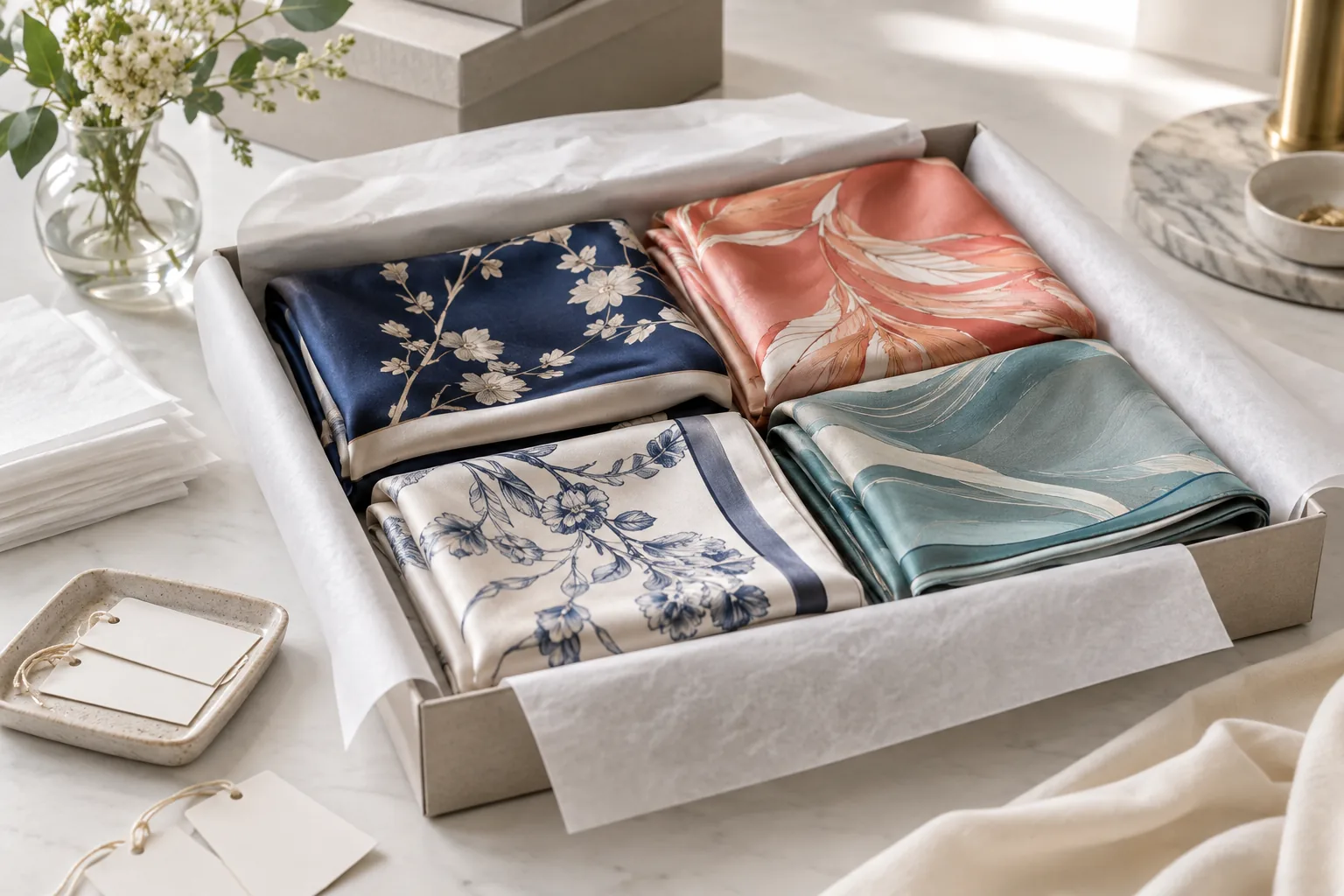
A finished custom silk scarf may leave production in excellent condition, yet still arrive at a boutique, warehouse or gifting event with avoidable creases, dust or packaging marks. The risk is rarely caused by one dramatic mistake. It usually comes from repeated handling, unstable storage, too much pressure or leaving silk exposed to light and moisture for longer than necessary.
This guide explains how to store silk scarves between receipt and final delivery. It is written for fashion brands, museums, corporate gift teams, retailers and e-commerce buyers managing commercial inventory—not for long-term museum conservation. For project-specific advice, always consider the scarf fabric, print, finish, embellishments, packaging and expected storage period.
Why storage planning matters after production
Silk is lightweight, flexible and naturally responsive to its surroundings. Those qualities create beautiful drape, but they also mean that pressure, folds and poor handling can change how a scarf looks when it is unpacked. A dark design may show dust; a pale design may show contact marks; a delicate surface can snag on a rough shelf or piece of jewellery.
Authoritative textile-care guidance consistently identifies light, moisture, heat, dust, pests, physical stress and unnecessary handling as common causes of textile damage. The Canadian Conservation Institute’s basic textile-care guidance recommends keeping textiles clean and dry, limiting bright light and supporting them during storage. These are sensible principles for commercial scarf inventory too, even though a new retail scarf does not require museum-level storage.
A simple storage plan protects more than the fabric. It helps maintain presentation consistency across an order, reduces last-minute steaming or repacking, and makes stock checks easier before launch, fulfillment or gifting.
Inspect scarves when the shipment arrives
Do not move every carton directly into long-term storage. First, select a clean, dry inspection area and compare the received goods with the approved sample and packing specification. The exact inspection level depends on the order size and your quality plan, but the process should be consistent.
Check the outer cartons and inner packaging
Look for crushing, water marks, punctures or unusual odours before opening a carton. If the exterior appears damp or damaged, isolate it from unaffected stock and document the condition. Avoid placing a questionable carton on top of clean retail packaging.
Review representative scarves
With clean, dry hands, check selected pieces for print appearance, hems, labels, visible marks, moisture, strong odours and packaging pressure. Remove rings, bracelets or other accessories that may catch fine fabric. If your order includes several colours, sizes or packaging versions, inspect each variation rather than assuming one sample represents all of them.
Record the result before repacking
Use the purchase order, colourway, carton number and inspection date in your internal record. Photograph any issue before changing the original packing. For a broader receiving workflow, use the custom silk scarf quality control checklist as a companion to this storage guide.
Keep silk clean, dry, dark and away from heat
A practical storage area should be clean, dry, protected from direct sunlight and separated from strong heat sources. Avoid placing scarf cartons directly against exterior walls, under leaking pipes or on a floor where water could reach them. Stable conditions are preferable to repeated swings between hot, humid and heavily air-conditioned environments.
Light damage is cumulative, so display samples and stock should not remain in direct sun for extended periods. Dust can also work into fabric and packaging, especially when boxes are left open. Close cartons or storage drawers after access, and use covers that do not transfer colour, odour or adhesive residue.
If goods have travelled through very different climates, allow sealed cartons to adjust in a clean indoor area before unpacking. Opening cold packages immediately in warm, humid air may encourage condensation. The correct acclimatization time depends on the route, packaging and conditions, so avoid treating a single time rule as universal.
Flat, rolled or hanging: choose the right method
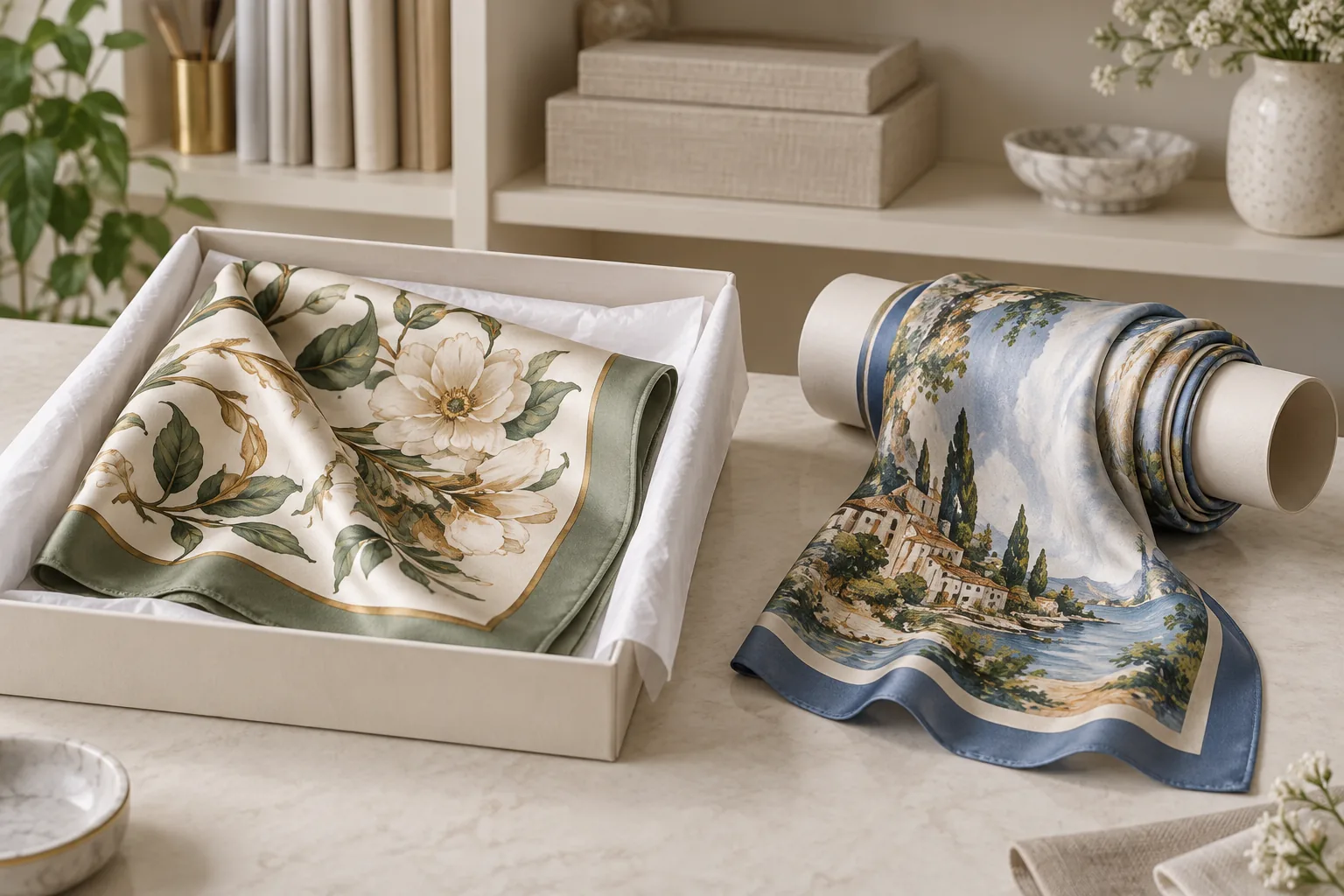
There is no single storage method for every scarf. Size, fabric weight, surface treatment, embellishment and storage duration all matter. Most ordinary square scarves are easiest to manage flat with minimal folds, while larger formats may benefit from loose rolling when suitable materials and space are available.
| Method | Best suited to | Main advantage | Watch for |
|---|---|---|---|
| Flat storage | Most square scarves and short-term retail stock | Supports the whole scarf and is easy to count | Over-stacking, sharp folds and box pressure |
| Loose rolling | Larger scarves, shawls and pieces that should avoid repeated fold lines | Reduces hard creases | Tight rolling, narrow tubes and exposed edges |
| Hanging | Short display or workflow use when the scarf is fully supported | Quick visual access | Clips, wire hangers, shoulder stress, dust and light |
How to store scarves flat
Use a clean, smooth box, drawer or shelf. Keep folds broad and loose. If a fold is unavoidable, support it with clean, neutral tissue so the fabric does not sit on a knife-sharp crease. Do not cram scarves into a container that is too small. When layering is necessary, keep stacks shallow and separate items so trims, labels or hardware do not press into the next scarf.
How to roll larger scarves
Use a clean tube or roll that is wider than the textile and has a generous diameter. Add a protective barrier if the tube material is not suitable for direct textile contact. Roll evenly without pulling the silk under tension, then protect the outside from dust and light. Label the outer cover so staff can identify the item without repeatedly unrolling it.
Why hanging is usually a temporary choice
Hanging can be convenient during photography, merchandising or packing, but narrow clips and wire hangers can concentrate pressure or leave marks. If hanging is necessary, use broad, smooth support and avoid placing weight on a single point. For long storage, flat or carefully rolled support is usually easier to control.
Prevent pressure marks, snags and colour transfer
Heavy products should never sit on scarf cartons. Even when the box looks intact, sustained pressure can create hard fold lines, flatten hand-rolled hems or imprint packaging components into the fabric. Store the heaviest cartons at the bottom of a stable shelving system and keep silk inventory away from sharp tools, exposed staples and rough unfinished wood.
Separate light and dark scarves when there is any concern about dye transfer, especially during long storage or humid conditions. Printed tissue, ribbons, adhesive labels and coloured inserts should also be assessed as part of the complete packaging system. If a new material will touch the scarf for an extended period, approve it during sampling rather than after bulk production.
Do not spray perfume, air freshener, disinfectant or pest treatment directly on scarves or inside their packaging. Odours and residues can be difficult to remove. Keep food, drinks, cleaning chemicals and fragranced materials away from the storage and packing area.
Organize retail, e-commerce and gifting inventory
A clear stock system reduces handling. Label cartons externally with the style, colourway, quantity and batch or purchase-order reference. Use a first-in, first-out workflow when appropriate, and schedule visual checks for inventory held across seasons. Inspection frequency should reflect the storage environment and the value and sensitivity of the goods.
Keep one approved reference sample separately protected for future comparisons. It should not be handled as an everyday sales sample. If the order uses special gift boxes, sleeves, belly bands or inserts, store a complete packed reference set so fulfillment teams can reproduce the approved presentation.
For packaging decisions, review the private label silk scarf packaging checklist. Packaging should protect the scarf through storage and transport while remaining practical for inspection and final presentation.
Pre-dispatch checklist
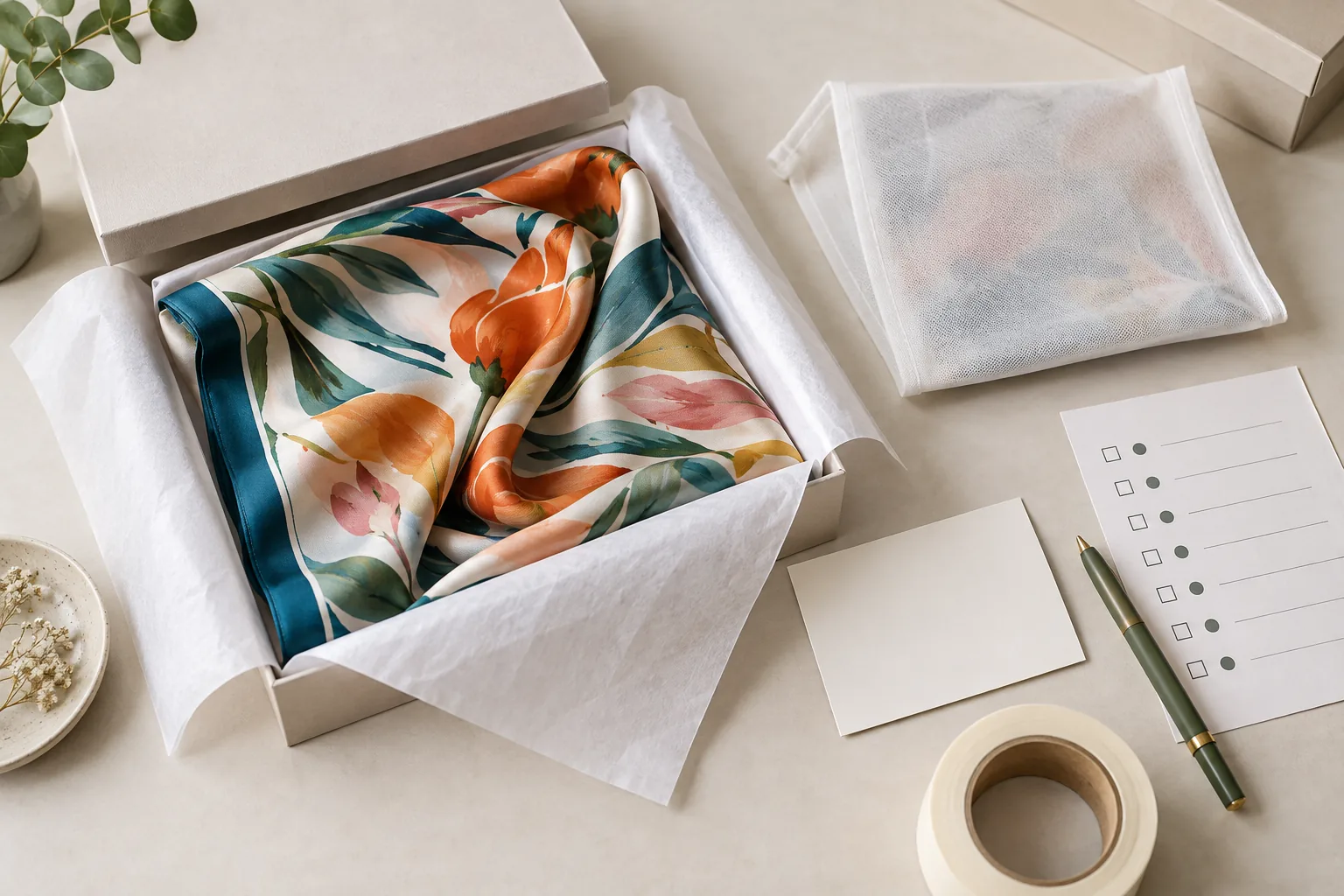
Before a scarf leaves storage for a shop, customer or event, complete a short final check:
- Confirm the correct design, colourway, size and label.
- Check that the scarf is clean, dry and free from unexpected odours.
- Inspect visible surfaces, hems and corners under neutral lighting.
- Remove only light loose dust with a method appropriate for the fabric; do not improvise aggressive cleaning.
- Refold or roll without creating hard new creases.
- Replace crushed, stained or torn packaging components.
- Confirm the care information, barcode, insert and gift message where applicable.
- Photograph the finished packed condition for high-value or presentation-critical projects.
If a scarf is stained, damp, mouldy or seriously creased, isolate it and ask a textile specialist or the supplier for advice. Heat, water and cleaning chemicals can affect silk, dyes and finishes differently; an untested quick fix may make the problem permanent.
Frequently asked questions
Should silk scarves be stored in plastic bags?
A bag should not be treated as automatically safe just because it is plastic. The material, ventilation, storage duration and risk of trapped moisture all matter. Avoid ordinary dry-cleaning garment bags and any packaging with a strong odour, sticky surface or unknown composition. Approve the complete packaging specification for your project.
Is it better to fold or roll a silk scarf?
Flat storage with minimal, supported folds works well for many square scarves and retail orders. Loose rolling can help larger scarves avoid repeated fold lines. The best choice depends on dimensions, fabric, surface detail, available space and how frequently the inventory will be accessed.
Can silk scarves be stored in direct sunlight if they are boxed?
Direct sunlight can heat packaging and may reach the textile whenever a box is opened or if the packaging is not fully opaque. A cool, dry indoor area away from direct sun is the safer routine for both stock and display samples.
How often should stored scarf inventory be checked?
There is no universal schedule. Base the frequency on storage duration, local humidity, building conditions, packaging and the importance of the goods. Inspect more often after a leak, climate-control failure, pest finding or other unusual event.
Should scarves be steamed before dispatch?
Only use heat or steam when the fabric, print, finish and care instructions allow it, and test the method first. Keep equipment clean and avoid water droplets. For severe creasing or uncertain materials, ask the manufacturer or a textile-care professional before treatment.
Plan storage and packaging before bulk production
The easiest time to prevent storage problems is before the order is packed. Share your fulfillment method, expected storage period, climate, retail presentation and gifting requirements during development. CarinaSilk can discuss scarf dimensions, folding, labels and packaging as part of your specification. Requirements and recommendations depend on the individual project.
Request a custom silk scarf quotation or sampling discussion, and tell us how the scarves will be stored, shipped and presented. You can also review our custom silk scarf manufacturing options before preparing your brief.