
- Foulard en soie personnalisé
- Cravate personnalisée
- Nœud papillon personnalisé
- Custom Print Fabrics
- Printed Satin Silk Fabric
- Printed Twill Silk Fabric
- Printed Silk Crepe De Chine Fabric
- Printed Silk Georgette Fabric
- Printed Silk Habotai Fabric
- Printed Silk Jacquard Fabric
- Printed Silk Cotton Fabric
- Printed Silk Viscose Fabric
- Printed Silk Linen Fabric
- Printed Silk Tencel Fabric
- Printed Silk Modal Fabric
- Printed Silk Wool Fabric


A scarf can look excellent on a design board and still create problems during a working shift. The knot may sit differently over a blazer, a loose end may move, or the approved color may look dull under cabin lighting. An airline uniform scarf wear test helps buyers identify those issues before they approve a bulk order.
This guide is a purchasing worksheet, not a safety standard. The airline’s uniform, cabin-safety, procurement and occupational-health teams should define their own acceptance criteria and approve every wearing method. A supplier can provide samples and specifications, but cannot replace the operator’s operational assessment. Australia’s Civil Aviation Safety Authority (CASA) recommends considering uniform material and design during uniform changes; its 2025 bulletin is advisory and does not itself establish minimum standards.
1. Write the test brief before requesting samples
Start with the job and uniform, not only the artwork. Is the scarf for cabin crew, ground staff, lounge teams or several groups? Which shirts, jackets, waistcoats and outerwear will be worn with it? Will the approved style be a neck knot, a tucked scarf, a pocket detail or another operator-approved method? Each configuration may change the required dimensions and the way the fabric behaves.
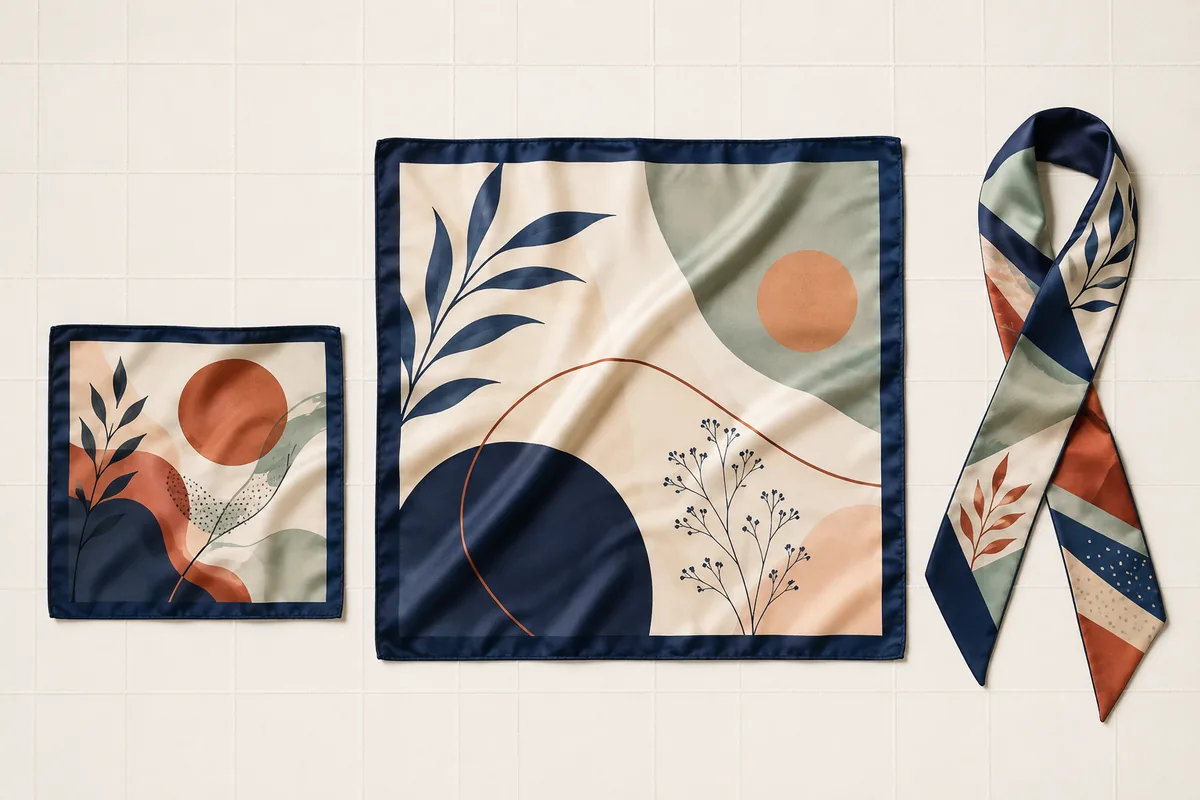
Give the sample maker a version-controlled brief: flat size, shape, fabric and weight, print method, front and back appearance, hem type, label placement, color references and proposed tying instructions. Include operator-specific care or material requirements. If more than one fabric or size is being evaluated, code each sample so testers can identify it. CarinaSilk’s airline scarf solution page outlines the customization choices; the wear test is the separate step that turns those choices into an approval decision.
Decide in advance who signs off design, operational safety, care instructions and the final purchase specification. A beautiful sample should not be assumed approved merely because one stakeholder liked the print.
2. Test the complete uniform combination
Have representative wearers try the scarf with the actual uniform and normally used accessories. Photograph the approved presentation from the front, side and back, using the same tying method for each comparison. Record whether the scarf maintains a consistent appearance across body sizes and whether the knot is easy to reproduce without special styling assistance.
Include normal movements relevant to the role: walking, reaching, bending, placing items, wearing outerwear and using required equipment. These observations are for the operator to assess, not a supplier’s declaration of safety. CASA’s guidance identifies loose accessories, including scarves, as a potential snag concern around fixtures such as door handles. The operator should review the proposed scarf length, free ends and approved tying method against its own procedures and equipment.
Do not ask wearers to stage unsafe scenarios. The cabin-safety team should decide what can be observed in a controlled setting and whether a design should be modified or rejected without a live trial. Resolve any conflict between styling and safe movement before artwork approval.
3. Record comfort and repeatability
A short fitting reveals only the first few minutes of use. Collect structured feedback after the scarf has been worn for a period the airline considers representative. Ask testers about neck pressure, heat, skin feel, slipping, knot bulk and how often they had to adjust it. Ask whether it interfered with a collar, lanyard, headset or outerwear. Leave space for comments that do not fit a checkbox.
Try the same approved tying method with multiple wearers. If an expert stylist is needed to make every knot look similar, the method may be impractical for routine use. Consider simple illustrated instructions. In one publicly documented uniform project, the LEVEL scarf was designed with crew participation and offered more than one way to wear it. That example supports involving intended wearers in feedback; it does not mean another airline should adopt the same wearing options.
Capture both the score and the reason for it. “Comfort: 3/5” is hard to act on; “knot presses against collar” points to a possible change in size, fabric or styling. Handle tester identifiers according to the operator’s policies.
4. Review appearance in real viewing conditions
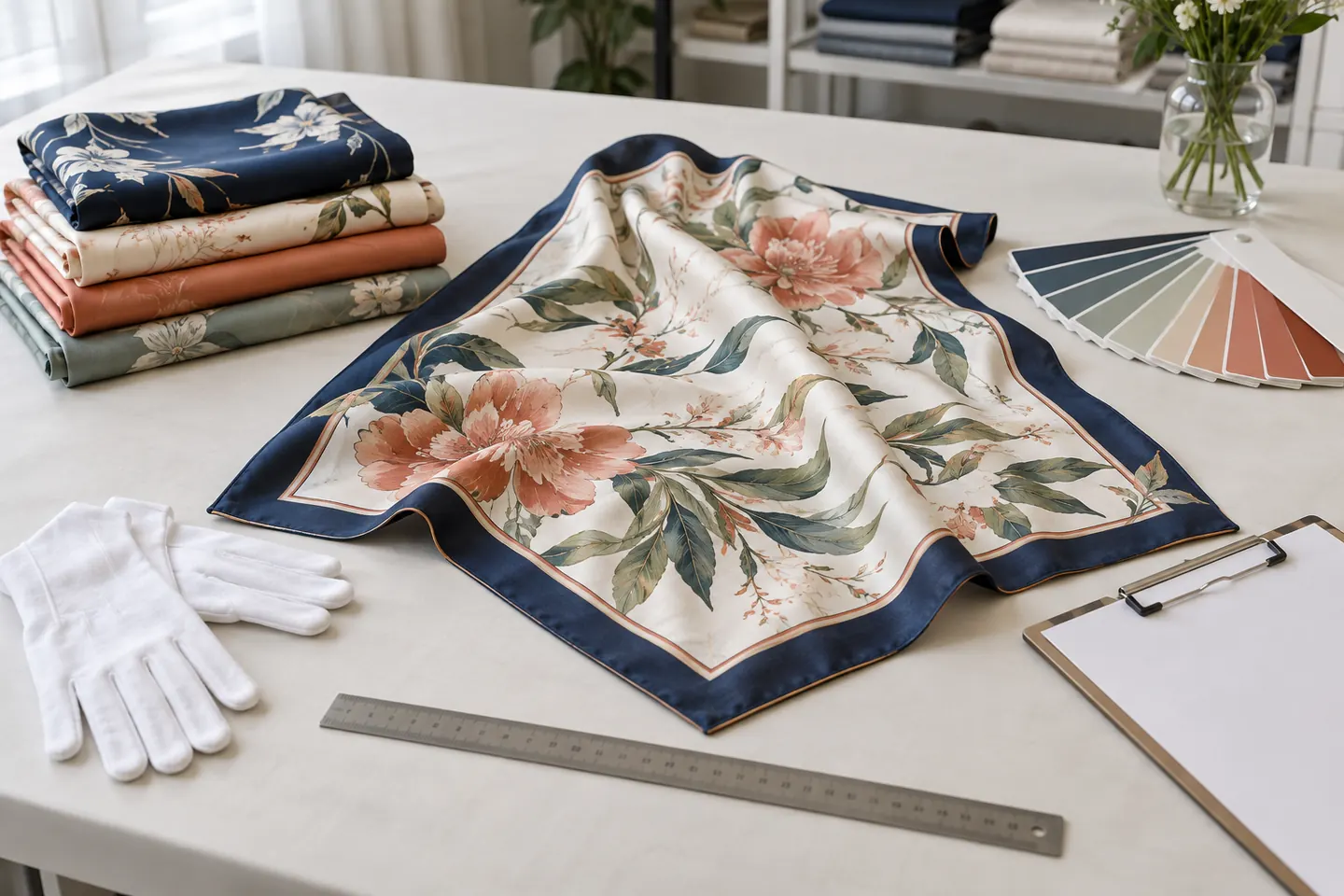
Assess the design where it will be seen: daylight, terminal lighting and cabin lighting if the operator can arrange a suitable review. Compare the physical sample with a signed color reference rather than a phone screen. Look at the scarf flat, folded and tied. A logo prominent in the artwork may disappear inside a knot; a border can read as a different color once folded.
Check right and reverse sides separately. A scarf may expose the reverse when it moves or is tied. That does not automatically call for double-sided printing: the required result depends on fabric, print method, design and wearing style. Specify what is acceptable on each side and assess the actual sample. Apply the same approach to hems and labels: decide which face and edge should be visible.
If the final design has multiple colorways, test each one. Do not assume a successful navy sample proves the contrast and brand visibility of a lighter variation. Photograph each approved configuration consistently; photos record appearance but do not replace physical color approval.

5. Run the care and durability checks your operator requires
Agree on a realistic care route before testing: home care, professional cleaning or a managed uniform-service process. Follow the proposed care instructions on the sample and record any change in hand feel, shape, color, print clarity, hem or label. The number of cycles, tolerances and any laboratory tests must be defined by the buyer or applicable operator specification; they should not be inferred from a marketing description.
Inspect common contact areas after normal wear: the knot, collar edge and points that touch a jacket or badge. Document snagging, abrasion, pilling or visible color transfer if observed. If colorfastness, flammability or other performance evidence is required, state the exact test method and acceptance threshold in the brief and request appropriate documentation. A visual wear trial is not a technical certification.
Keep a control sample untouched for comparison. A worn sample alone does not show whether a subtle change occurred. When revisions are made, test the revised sample again against the same criteria; a fabric or print-process change can affect several properties.
6. Use one decision sheet for every sample
A shared sheet keeps feedback from becoming scattered across emails and chats. Define “pass,” “revise” and “reject” before testers start. The suggested owners below are examples, not a claim about every airline’s organization.
| Check | What to record | Suggested owner |
|---|---|---|
| Fit and tying | Approved knot, free-end length and consistency across wearers | Uniform team |
| Movement review | Interference, snag concern or adjustment during role-specific movement | Operator safety team |
| Comfort | Pressure, heat, fabric feel and comments after representative wear | Wear-test lead |
| Brand appearance | Color, logo visibility and reverse-side appearance | Brand and uniform teams |
| Care and quality | Approved care route, observed changes and required test reports | Quality team |
| Production handoff | Final sample ID, artwork version and sign-off date | Procurement |
Attach a photo or note where it explains a decision. Mark outstanding issues with an owner and due date. Avoid an overall “approved” status while safety or care questions remain unresolved.
7. Lock the approved sample before bulk production
Once the operator approves a sample, record the physical reference and digital files that production must match. Include dimensions and agreed tolerances, fabric, print method, color references, hems, labels, packaging and wearing instructions. Keep the signed sample or a controlled reference in an identifiable place. Route any later substitution through the same approvers rather than treating it as equivalent by default.
Confirm how a pre-production or production sample will be compared with the reference. The scope and timing of sampling depend on the specification. For ordering steps, see how to order custom scarves. A precise handoff helps both buyer and maker resolve disagreements and repeat a successful order.
Frequently asked questions
Who should approve an airline scarf wear test?
The airline should name its uniform, safety, brand, quality and procurement approvers before sampling. A supplier can help resolve production questions but cannot grant operational approval on the airline’s behalf.
Is a quick fitting enough?
Usually not for a new specification. A fitting shows immediate appearance; representative wear can reveal comfort, adjustment and consistency issues. The operator decides suitable duration and conditions.
Should every wearing style be tested?
Yes, if the operator intends to approve more than one style. A neck knot, tucked treatment or pocket presentation can expose different parts of the print and create different fit and movement considerations.
Does a wear test prove a scarf is safe or compliant?
No. It is one part of the operator’s evaluation. Required material tests, regulatory review and workplace approval must be defined and completed by the responsible parties.
What should I send when requesting samples?
Send artwork, brand colors, desired size and fabric, intended uniform and wearing method, care requirements, expected use and operator-defined test criteria. State what is fixed and what is open to recommendations.
Request a sample for your uniform review
Planning an airline or ground-staff scarf project? Share your artwork, uniform context, proposed wearing method and approval checklist through the CarinaSilk contact page. Ask for a sample discussion and quotation based on your specifications. Material options, sampling and production terms depend on the final brief; approve the physical reference before a bulk order.
Source note
The operator-safety distinction above is informed by CASA Cabin Safety Bulletin 28 (2025), which is advisory, not a new minimum standard. The crew-participation example comes from Universitat Ramon Llull’s account of the LEVEL scarf project. Neither organization endorses this article or CarinaSilk.