
- Custom Silk Scarf
- Custom Tie
- Custom Bow Tie
- Custom Print Fabrics
- Printed Satin Silk Fabric
- Printed Twill Silk Fabric
- Printed Silk Crepe De Chine Fabric
- Printed Silk Georgette Fabric
- Printed Silk Habotai Fabric
- Printed Silk Jacquard Fabric
- Printed Silk Cotton Fabric
- Printed Silk Viscose Fabric
- Printed Silk Linen Fabric
- Printed Silk Tencel Fabric
- Printed Silk Modal Fabric
- Printed Silk Wool Fabric


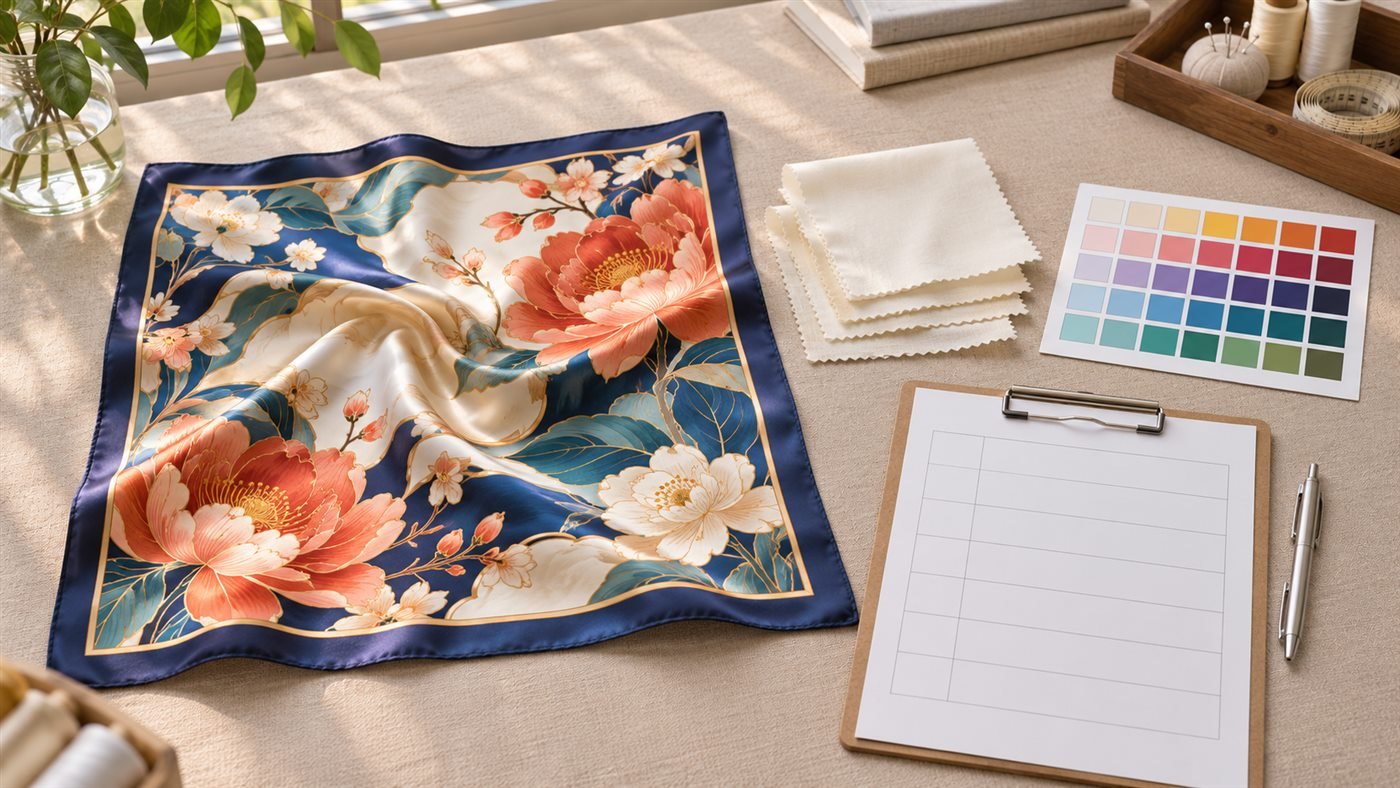
A custom silk scarf can look convincing in an artwork proof and still behave differently when rubbed against a light jacket, exposed to perspiration, or cleaned. For a buyer, “colorfastness” is not one pass-or-fail promise. It is a set of questions about whether a particular fabric, print, colorway and care instruction suit the scarf’s intended use.
This guide is a practical test-planning framework for brand, uniform and wholesale buyers. It does not prescribe a universal passing grade or mean every scarf needs every laboratory test. Agree on end use, methods, samples and acceptance criteria before bulk production.
What does colorfastness mean for a silk scarf?
Two outcomes matter. Color change describes a visible change in the scarf itself. Staining describes color transferred to another material, such as a white blouse or lining. A report may assess these separately. A vivid print can retain its appearance yet transfer color when rubbed; conversely, a pale motif may change shade without staining adjacent fabric. Ask which outcome the buyer needs to control.
Colorfastness depends on the exact combination of silk fabric, dyes or printing process, finishing, color depth and care conditions. A result for one dark colorway should not be assumed to represent every variant in a collection. An approved artwork file is not a substitute for testing a physical, production-representative sample.
Choose tests from the scarf’s real use
Start with the situations a scarf will encounter. A fashion accessory worn occasionally has a different exposure profile from a uniform scarf worn through a full shift. A museum-shop scarf may be displayed near light for weeks. A gift scarf’s care label may specify professional cleaning rather than home washing. Use the table as a discussion guide with your supplier and test laboratory, not as an automatic specification.
| Buyer scenario | Potential issue | Test to discuss | Report question |
|---|---|---|---|
| Dark scarf against a light garment | Transfer during wear | Dry and wet rubbing | Was staining measured on adjacent cloth? |
| Uniform or warm-weather use | Perspiration contact | Perspiration fastness | Were color change and staining assessed? |
| Display or prolonged daylight exposure | Fading | Light fastness | Does exposure match intended display? |
| Care label allows washing | Change after cleaning | Laundering fastness | Do conditions reflect the care instruction? |
| Care label specifies dry cleaning | Color change in solvent | Dry-cleaning colorfastness | Is this only a colorfastness assessment? |
Rubbing: dry and wet contact
Rubbing tests examine transfer from the colored textile to a standard white cloth under defined conditions. Wet and dry conditions are separate; neither is a general guarantee against staining in every real-world situation. AATCC TM8 addresses dry and wet crocking, while ISO 105-X12 covers rubbing for dyed or printed textiles. Ask the laboratory to identify the actual method and face of fabric tested, especially if front and reverse look different.
Perspiration and water
For scarves worn close to the neck, perspiration is a sensible risk to consider. ISO 105-E04 is one recognized method for assessing colorfastness to perspiration. Water exposure is a separate question addressed by methods such as ISO 105-E01. A controlled test does not predict every combination of cosmetics, sunscreen, fragrance, heat and wear. If those exposures are important, discuss them explicitly with a qualified laboratory.
Light and the proposed care method
If a scarf will spend significant time in a window display or under strong light, discuss light fastness rather than relying only on rubbing or washing results. AATCC’s current standards index lists TM16.3 for light exposure. Cleaning tests must match the claim on the proposed care label. ISO 105-C06 addresses colorfastness to domestic and commercial laundering; ISO 105-D01 addresses colorfastness to dry cleaning in perchloroethylene, but does not by itself evaluate all aspects of dry-cleaning performance. Do not request a wash test merely because it is familiar if the product is not intended to be washed that way.
Specify samples that represent the order
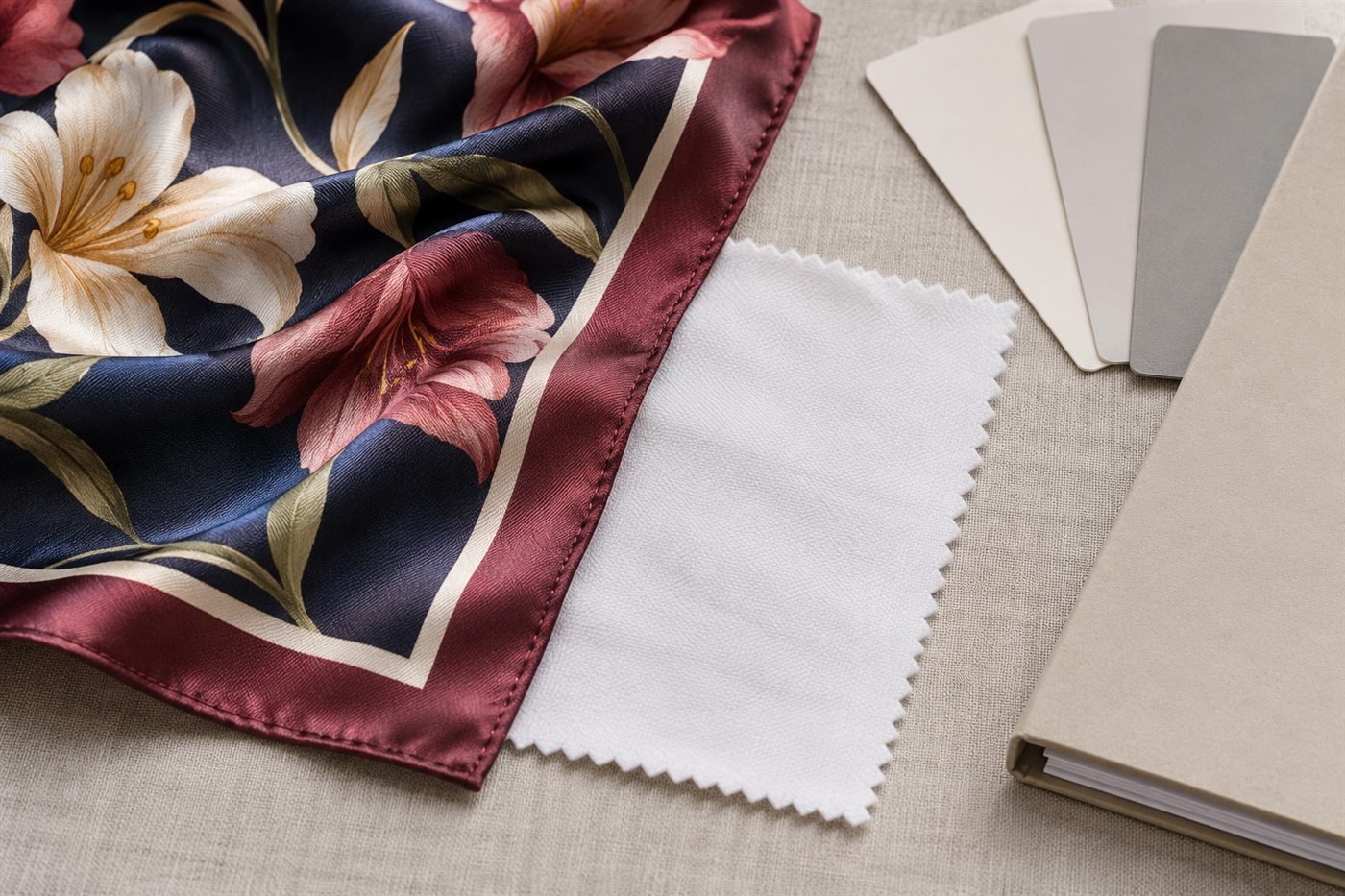
A useful test plan identifies exactly what is being tested. Send or retain a sample record with the fabric construction, weight if specified, print or dye route, finishing, approved artwork version, colorway, production stage and intended care instruction. If a design combines deep navy, red and pale cream, ask which areas are sampled. Dark, saturated fields and high-contrast boundaries can be important to assess, but the lab should determine specimen preparation for the chosen method.
For a collection, decide whether a worst-case colorway can reasonably represent other variants or whether each needs separate assessment. This is a risk and specification decision, not a universal shortcut. If the supplier changes fabric, ink or dye route, finishing, or a major color after approval, revisit the plan. The final test sample should be traceable to the approved production specification—not just a visually similar development swatch.
Read the laboratory report before approving bulk production
Do not stop at a single grade highlighted in an email. Check the report’s sample identification, test-method number and edition, conditions, date, color-change result, staining result where relevant, and comments or limitations. Compare each result with the acceptance criteria agreed in the purchase specification. If a report says “pass,” find out whose requirement it passed. The test standard describes how to measure; it does not automatically set your brand’s acceptance threshold.
When a result is marginal or unexpected, confirm that the laboratory tested the right scarf under the right conditions. Then discuss whether a revised print, finish or care instruction is appropriate and whether retesting is needed. Do not quietly substitute a different sample or assume a second test removes the underlying risk. Keep the approved report with the physical approval sample and production records.
A buyer’s colorfastness approval checklist
- Define end use, wearer, display conditions and expected care.
- List the actual fabric, print process, finish and colorways represented.
- Agree on methods and whether to evaluate color change, staining or both.
- Set acceptance criteria in writing before testing; avoid “good fastness.”
- Label and retain a production-representative physical sample.
- Check the report’s sample ID, method, conditions, results and limitations.
- Confirm that approved care wording and tested conditions are consistent.
- Record changes that would trigger new sampling or testing before reorders.
This checklist works alongside a broader ordering and sample-approval process. Colorfastness is one part of quality control; sizing, print alignment, hems, labeling and packaging need their own checks.
Frequently asked questions
Does every custom silk scarf need the same tests?
No. Select tests from intended wear, exposure, care claims and buyer requirements. Agree on scope and acceptance criteria for the project.
Can a digital artwork proof prove colorfastness?
No. A screen or paper proof helps approve artwork and color direction, but colorfastness is assessed on a physical textile sample under a defined method.
Is a dry-rubbing result enough for a scarf worn against a white shirt?
Not necessarily. Dry and wet rubbing differ. Perspiration may also matter for neckwear. Discuss the actual exposure rather than extrapolating from one result.
What is an acceptable grade?
There is no single grade for every scarf, market or buyer. Agree on the scale and required result before testing, then compare the report against that written specification.
Should a reorder be tested again?
Review whether fabric, colorway, print route, finishing, care instruction or production conditions have changed. Your purchase specification should define when retesting is required.
Plan your next custom silk scarf project
If sourcing custom silk scarves, send intended use, artwork, fabric preference, colorways, quantity and proposed care instructions with your inquiry. Ask which physical samples and colorfastness tests are relevant before approving bulk production. Contact Carina Silk for a quotation or sampling discussion; test scope, cost and timing depend on the final specification.
Methods referenced: AATCC TM8 and the AATCC standards index; ISO 105-X12, ISO 105-E04, ISO 105-E01, ISO 105-C06 and ISO 105-D01. Ask your laboratory which current edition and conditions apply to your product.