
- Шелковый шарф на заказ
- Галстук на заказ
- Галстук-бабочка на заказ
- Custom Print Fabrics
- Printed Satin Silk Fabric
- Printed Twill Silk Fabric
- Printed Silk Crepe De Chine Fabric
- Printed Silk Georgette Fabric
- Printed Silk Habotai Fabric
- Printed Silk Jacquard Fabric
- Printed Silk Cotton Fabric
- Printed Silk Viscose Fabric
- Printed Silk Linen Fabric
- Printed Silk Tencel Fabric
- Printed Silk Modal Fabric
- Printed Silk Wool Fabric



A custom silk scarf can match its approved sample and still develop problems during bulk production, finishing, labeling or packing. That is why a final inspection should compare the shipment with a controlled specification rather than rely on a quick visual impression.
This custom silk scarf quality control checklist is written for fashion brands, museum shops, corporate gifting teams and wholesale buyers. It explains what to inspect before shipment, what evidence to retain and where laboratory testing fits into the process. The exact scope, sampling plan, tolerances and acceptance criteria should always be agreed for the individual order.
Start with the approved production reference
Quality control works only when everyone is comparing the product with the same target. Before inspection begins, gather the latest approved sample and the final written specification. Each document should carry a clear style number, colorway, revision and date so an outdated file cannot quietly become the inspection standard.
The reference pack should identify the scarf shape and finished dimensions, fabric construction and weight specification, artwork version, printing construction, edge finish, labels, packaging and quantity by SKU. If the project is still at the development stage, use the custom silk scarf sample approval checklist before authorizing bulk production.
A physical sample is particularly useful for appearance, hand feel and workmanship. However, it should not replace written measurements or test requirements. A retained sample can change with handling, light and age, while a specification gives the inspector a reproducible basis for recording results.
Define the inspection plan before goods are packed
Do not wait until the shipment is ready to decide what “acceptable” means. The purchase documents should state who will inspect, when the inspection will occur, how pieces will be selected, which characteristics will be checked and how findings will be classified.
Some buyers request a complete visual check, while others use an acceptance-sampling plan for defined attributes. The ISO 2859 family describes sampling systems for inspection by attributes, and the official ISO 28590 overview explains how the related standards fit together. A buyer should not copy an AQL number from another product without considering the order, defect risk and contractual requirements. If formal sampling is needed, agree the applicable standard, inspection level, sample size and acceptance criteria with a qualified quality professional.
Create practical defect categories
A defect list should be specific enough that two inspectors reach a similar conclusion. It can distinguish issues that affect safety or legal compliance, issues that make the product unusable or commercially unacceptable, and smaller workmanship variations. The final names and thresholds are buyer decisions and may differ by market position.
Photographs help remove ambiguity. Show both acceptable and unacceptable examples for sensitive points such as border alignment, print marks, hem appearance, corner shape, label position and packaging damage.
Custom silk scarf quality control checkpoints
The table below organizes the main checks. It is a planning tool, not a universal acceptance standard. Replace general descriptions with the measurements, references and tolerances agreed for your project.
| Inspection area | Compare against | Typical questions |
|---|---|---|
| Identity and quantity | Purchase order and SKU list | Are the design, colorway, size and counts correctly separated? |
| Fabric | Approved specification and sample | Does the construction, weight direction, hand feel and surface match the brief? |
| Print and color | Approved print reference | Are color, detail, placement, gradients and reverse appearance consistent? |
| Dimensions and shape | Measurement chart | Are the agreed points measured using the same method and within the stated tolerance? |
| Edges and corners | Approved finish reference | Are hem type, roll direction, stitch appearance and corners correct? |
| Labels and branding | Approved artwork and placement diagram | Are wording, orientation, position and attachment correct? |
| Packaging | Approved packed sample and packing list | Are the fold, inserts, SKU labels, protection and carton assortment correct? |
1. Verify product identity and assortment
Begin with the basics. Confirm that carton marks, packing lists and the physical contents refer to the same purchase order. Check the quantity by design, colorway and size, including mixed assortments. A technically well-made scarf can still be a serious delivery problem if it carries the wrong SKU, label or retail pack.
2. Inspect the silk surface and hand feel
Unfold each selected piece on a clean surface under consistent light. Look across the whole scarf for unintended stains, pulls, snags, holes, creases, weaving marks or handling damage. Compare the fabric’s appearance, opacity, drape and hand feel with the approved reference rather than with memory.
Fabric composition and performance cannot always be proven by sight or touch. If fiber identification, fabric weight or another property is contractually important, specify the evidence or test method separately.
3. Review print quality and color consistency
First inspect the scarf from normal viewing distance, then examine fine areas closely. Check logos, lettering, outlines, gradients, borders and repeated motifs for clarity and intended placement. Look for banding, smudging, unintended marks, missing detail, registration problems or abrupt color changes.
Compare color under a consistent viewing condition with the approved printed silk reference. A screen image or HEX value is not a substitute for the physical approval because fabric weave, sheen and light affect perception. For a deeper color workflow, see the Pantone color matching guide for custom silk scarves.
Turn the piece over and compare the reverse with the selected printing construction. A single-sided print, a single-layer double-sided print and a two-layer reversible scarf should not be judged by the same expectation.
4. Measure finished dimensions and shape
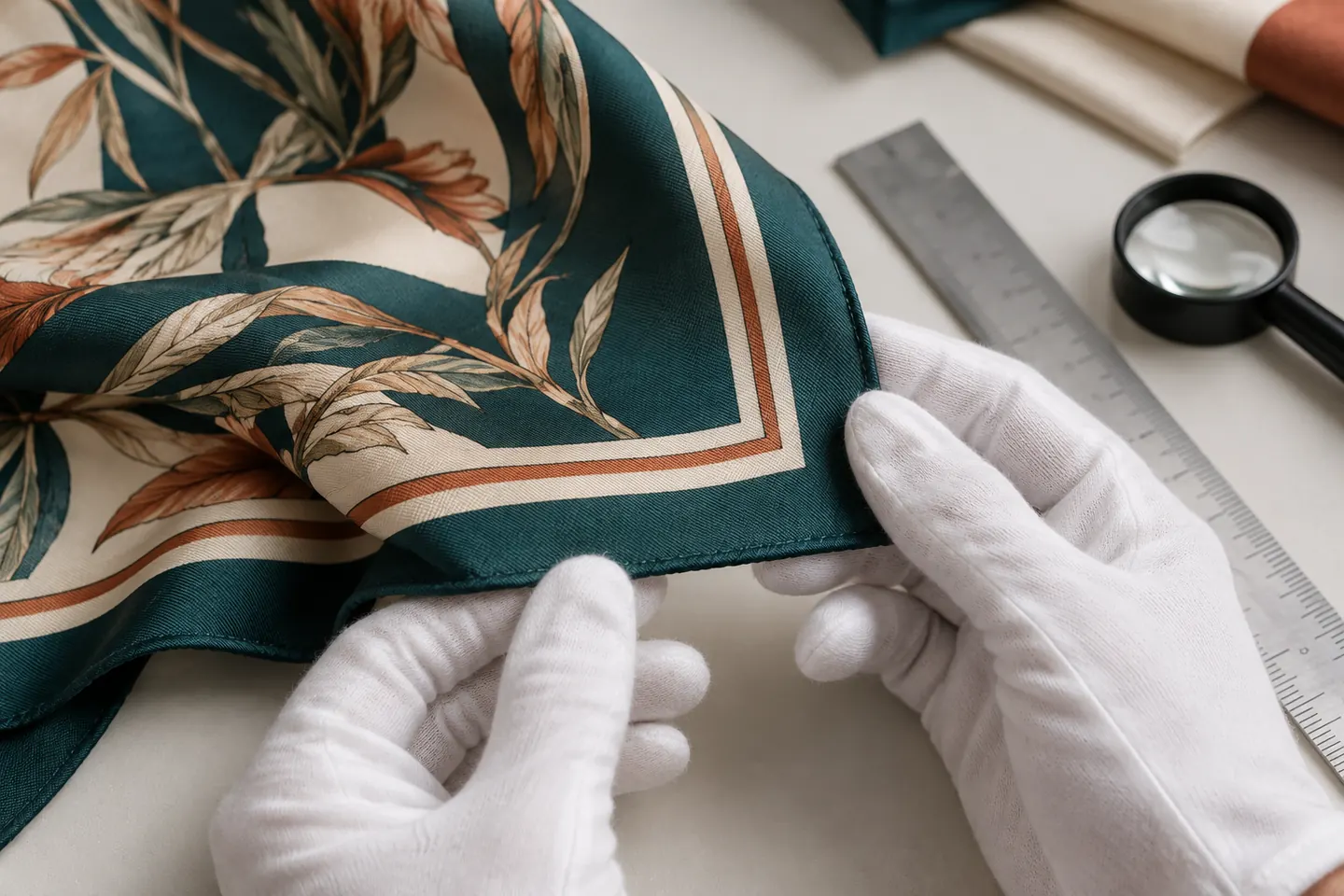
Use the measurement method agreed in the specification. Lay the scarf flat without stretching, identify the stated measurement points and record the results. For a square, measuring more than one side can reveal shape distortion. For a long scarf, checking width at several positions can show inconsistency that one measurement would miss.
Finished-size tolerance depends on the fabric, dimensions, edge construction and buyer requirement. It should be written before production rather than negotiated after inspection. If the format itself is still being selected, consult the custom silk scarf sizes guide.
5. Examine hems, corners and thread
Inspect every side and more than one corner. Confirm the intended hem type, visible profile, roll direction and thread color. Look for loose or skipped stitches, exposed raw edges, puckering, excessive waviness, bulky corners and unintended distortion of the printed border.
Hand finishing can show controlled variation, while machine finishing is usually selected for a more regular visual result. The correct decision is whether the workmanship matches the approved reference and the standard defined for that product—not whether every scarf resembles a different brand’s construction.
6. Check labels and brand components
Compare brand labels, care labels, origin information, hangtags and barcode labels with their final approved files. Check spelling, language, orientation, material, position and attachment. Confirm that the correct component is matched to each SKU and that placement does not interfere with drape or the intended front of the scarf.
Legal labeling requirements vary by product and destination. The buyer or importer should confirm the applicable wording with a qualified adviser and provide approved instructions rather than asking the inspector or factory to infer them.
7. Verify folding, packaging and shipment readiness
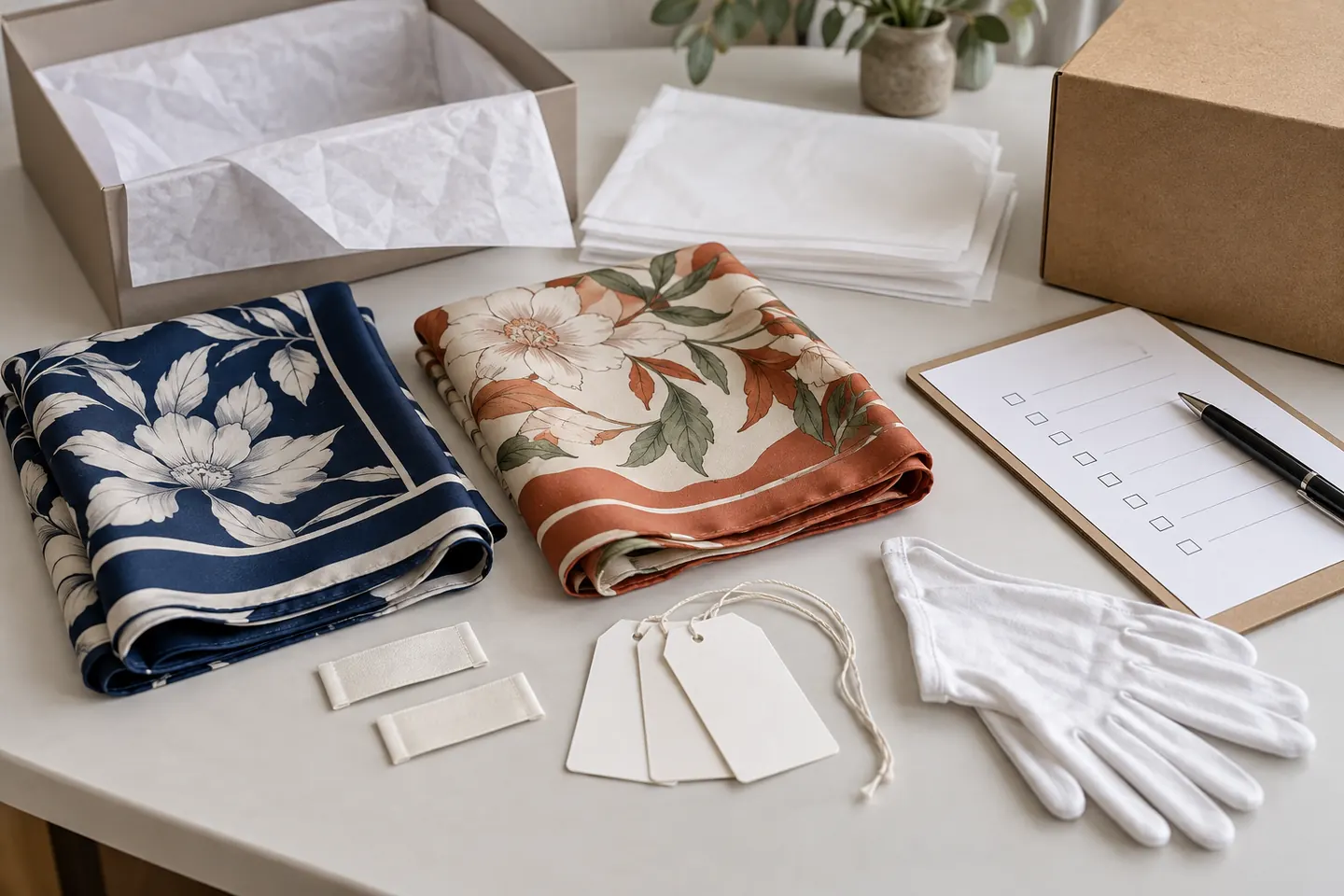
Inspect the product as the customer will receive it. Confirm the fold, tissue or protective layer, insert, tag, presentation pack and SKU identification. Look for unwanted pressure marks, trapped threads, color transfer, odor, excess adhesive, crushed corners or inconsistent assembly.
For mixed cartons, compare the assortment with the packing list. Check that the outer protection and carton arrangement match the agreed shipping configuration. Packaging approval is part of product quality because an undamaged scarf can still arrive in an unusable retail pack.
Separate visual inspection from laboratory testing
A visual inspection can identify workmanship and specification problems, but it cannot confirm every performance property. If the end use or destination requires colorfastness, fiber analysis, dimensional change or another test, name the method and acceptance requirement in the order documents.
AATCC publishes textile test methods covering subjects such as crocking, perspiration, accelerated laundering, fiber analysis and dimensional change. Its official test-method directory helps buyers and laboratories identify the appropriate reference. The relevant test depends on the actual product, care method, market and risk; do not assume that every scarf needs every test or that appearance predicts a laboratory result.
What a useful inspection report should contain
A report should allow someone who was not present to understand what was inspected and how the decision was reached. Ask for:
- Purchase order, style, SKU, colorway and revision identifiers
- Inspection date, location and production status
- Declared quantity and the sampling method used
- Approved sample and specification references
- Measurements and results for each checkpoint
- Defects recorded by type, location and classification
- Clear photographs, including overall views and close-ups
- Packing, assortment and carton observations
- Any laboratory reports required by the purchase documents
- A clear pass, fail or hold decision under the agreed criteria
If a problem is found, record the affected quantity or inspected sample, the corrective action, who is responsible and what evidence is needed for reapproval. Do not close an issue with an ambiguous note such as “factory will improve.”
Final pre-shipment checklist for buyers
- Confirm that production is sufficiently complete for the intended inspection.
- Use the latest approved sample and controlled specification.
- Verify quantities, SKUs, colorways and assortment.
- Inspect fabric surface, hand feel and obvious damage.
- Review print clarity, placement, color and both faces.
- Measure finished dimensions using the agreed method.
- Inspect hems, corners, stitches and thread color.
- Check every label, tag and barcode against approved files.
- Review folding, presentation packaging and carton packing.
- Attach any required laboratory results to the inspection record.
- Document findings with clear photographs and measurements.
- Release, hold or reject the shipment only under the agreed decision rules.
Frequently asked questions
Is a pre-shipment inspection the same as sample approval?
No. Sample approval defines the intended product before bulk production. A pre-shipment inspection checks whether the completed production lot follows that approved reference and the written specification.
Should every custom silk scarf be inspected?
The appropriate scope depends on quantity, product risk, buyer requirements and the agreed quality plan. Some characteristics may receive a complete check, while others may be reviewed through an agreed sampling method. Define this before production.
Can photographs replace an independent inspection?
Photographs are useful evidence but show only selected views. Whether remote documentation is sufficient depends on the order value, risk and buyer controls. A buyer may choose supplier reporting, its own representative or a qualified third-party inspector.
What should happen if the inspection fails?
Place the shipment on hold, document the findings and compare them with the agreed criteria. The parties should define corrective action and reinspection evidence before release. The response depends on the defect, affected quantity and contract.
When should laboratory testing be arranged?
Plan it when the specification is created. Testing may need material from the intended production combination, and the method, laboratory, sample selection and acceptance requirement should be agreed before the result is needed.
Prepare a quality-control brief for your scarf project
For a project-specific quotation and sampling discussion, send CarinaSilk your artwork, scarf dimensions, fabric direction, quantity by design, printing construction, finishing, labels, packaging, destination and required inspection or testing documents. Requirements vary with the specification, so list open decisions instead of guessing.