
- 맞춤 실크 스카프
- 맞춤 넥타이
- 맞춤 나비 넥타이
- Custom Print Fabrics
- Printed Satin Silk Fabric
- Printed Twill Silk Fabric
- Printed Silk Crepe De Chine Fabric
- Printed Silk Georgette Fabric
- Printed Silk Habotai Fabric
- Printed Silk Jacquard Fabric
- Printed Silk Cotton Fabric
- Printed Silk Viscose Fabric
- Printed Silk Linen Fabric
- Printed Silk Tencel Fabric
- Printed Silk Modal Fabric
- Printed Silk Wool Fabric


A supplier can quote a custom silk scarf only as accurately as the brief allows. “What is the price for 500 silk scarves?” leaves open the fabric, size, artwork, printing, edge finish, labels, packaging, destination and number of designs. Two suppliers may answer using different assumptions, making their prices impossible to compare.
This custom silk scarf RFQ guide is for brands, retailers, museums and corporate buyers who want a useful first quotation without pretending every detail is final. An RFQ (request for quotation) describes the product and the commercial questions you want a manufacturer to answer. It is not a purchase order or an approved production specification. The goal is to replace vague estimates with a clear, comparable starting point.
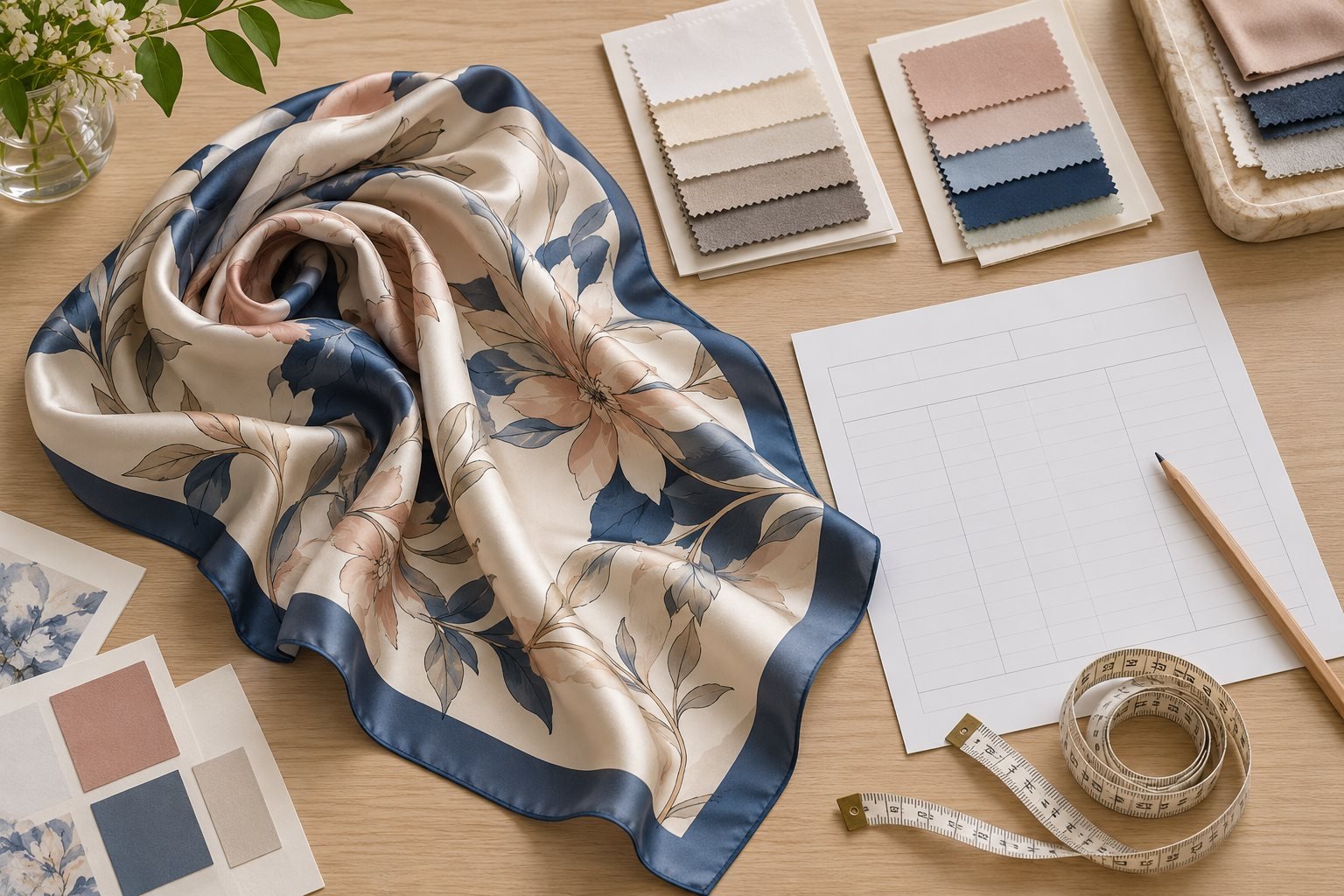
Why a detailed RFQ produces a more useful quote
Price is only one part of a sourcing decision. A clear RFQ helps a supplier identify technical questions early, suggest feasible options and separate sample costs from bulk production and shipping. It also helps your team compare like with like. A quotation for one design with a simple machine hem should not be compared directly with a quotation covering several colourways, hand-finished edges and individual gift boxes.
General procurement guidance makes the same point: a specification should describe what is being bought. The UK government’s technical-specification guidance identifies quality, dimensions, production methods, packaging, marking and labelling as possible characteristics. Your scarf brief does not need to become a formal public tender, but these are practical categories to consider.
Start with the buyer’s intended use
Tell the manufacturer whether the scarf is for fashion retail, a museum shop, an employee gift, a wedding, a promotional event or another use. Explain who will wear it, how it will be displayed, and whether it must fit existing packaging or merchandising. An elegant square scarf for a boutique and a narrow uniform accessory may require different dimensions, fabric weight and folding methods even when both are described as silk scarves.
If there is a launch date, give the date the finished goods need to arrive, not just the event date. Include your destination country and whether you want production only or shipping discussed as well. Do not assume a requested date is feasible until the manufacturer has reviewed the artwork, sampling and final specification. Lead times depend on the project and should be confirmed in the quotation.
Specify the product before asking for a unit price
Size, shape and quantity
State the intended finished size in centimetres or inches and whether the scarf is square, rectangular, narrow or another shape. Specify quantity per design and per colourway, not only the total order. If size is undecided, list two alternatives and request separate prices. Dimensions affect fabric use, layout and finishing. A realistic reorder forecast can be useful, but do not promise a volume you cannot support.
Fabric fibre, weave and weight
Silk alone does not define a fabric. State whether you require 100% silk, a silk blend, or are open to alternatives. If you know the desired weave and weight, include them; otherwise describe the hand feel and appearance you want and ask for sample options. A lightweight, airy scarf and a more substantial structured scarf may need different substrates. Fabric name, composition and weight should be confirmed against an actual swatch before the order is finalized.
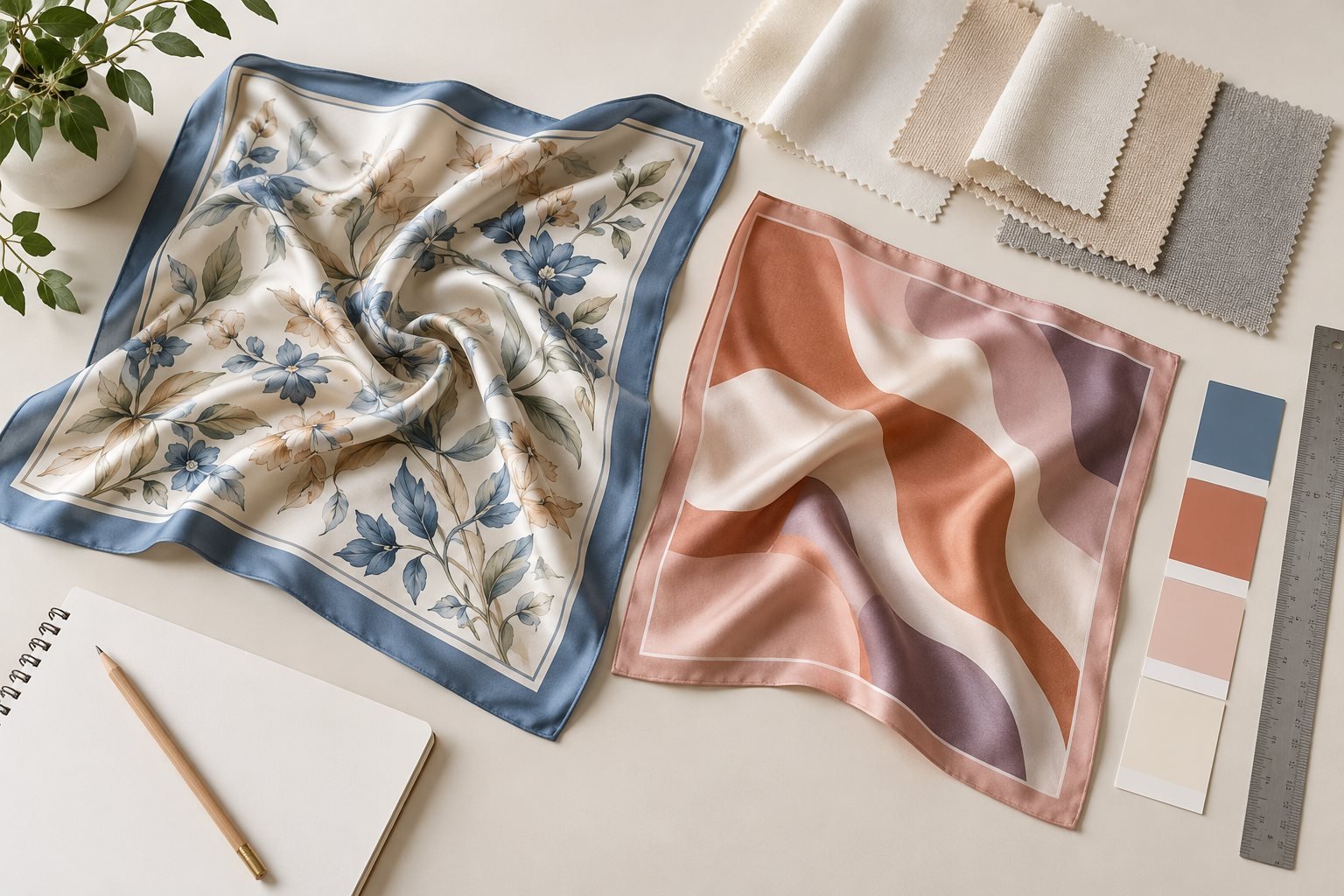
Artwork and colour requirements
Attach the current artwork or a visual reference and label it clearly as final, in progress or inspiration only. Include the number of designs, colourways, border placement and any logo position. State whether a colour standard or approved physical reference must be matched. Screen previews can differ from printed silk, so agree on how colour will be approved during sampling. If artwork is not ready, request an indicative quote based on stated assumptions and ask what file format and resolution the supplier needs later. Our artwork preparation guide covers the next design-file step.
Printing, edge finish and labels
Tell the supplier whether the print should be visible on one side or intentionally printed on both sides, and ask them to explain the proposed method. Specify whether you prefer a hand-rolled edge, machine hem or are open to comparison. Add any woven brand label, care label, hangtag or barcode requirements. Do not leave these items until after a sample price has been quoted; they can change both production work and the packed presentation.
Packaging and delivery format
Describe the packing unit: individually folded, tissue-wrapped, placed in a branded box, grouped for wholesale cartons or prepared for fulfillment. State any inserts or retailer labelling. Packaging is part of the finished product, not just a shipping afterthought. If several packaging options are under consideration, request an itemized price for each rather than one blended figure.
A compact RFQ checklist you can copy into an email
| Field | Information to provide | If undecided |
|---|---|---|
| Use and market | Retail, gifting, uniform or other purpose; destination country | Explain likely use and ask for suitable options |
| Format | Finished size, shape and quantity by design/colourway | Request separate quotes for two formats |
| Fabric | Fibre composition, weave, weight or target hand feel | Ask for named swatches and pricing assumptions |
| Design | Artwork status, colours, logo and border placement | Share a marked concept and identify open decisions |
| Production | Printing preference, edge finish, labels | Ask for an option-by-option comparison |
| Packaging | Fold, tissue, box, insert, barcode and carton needs | Request a base price plus optional additions |
| Commercial | Sampling request, target arrival date and destination | Ask what information is needed for a firm quote |
You can write “to be confirmed” beside an open decision. What matters is making uncertainty visible. Ask the supplier to state the assumptions behind every provisional price so that you can update the quote without losing track of what changed.
Ask for a comparable, itemized response
A helpful supplier response should identify the exact configuration being priced and the quantity basis. Ask for unit prices at quantities relevant to your launch, plus separate lines for sampling, artwork support if applicable, labels, packaging and freight if offered. Request the currency, quotation validity and delivery terms in writing. For an international order, clarify the point at which delivery responsibility changes; do not assume “shipping included” covers duties, taxes or final-mile handling.
Ask what the price excludes. Are physical samples, colour revisions or special boxes outside the base quote? Is the quoted size measured before or after hemming? Does the quote cover one design or several? These questions are more useful than trying to force every supplier into the lowest headline unit price.
If testing or documentation matters for your destination market, specify the required standard and acceptance criteria before quoting. The AATCC standards catalogue lists distinct textile methods for rubbing, light, washing and other performance questions. The suitable method and target result depend on the scarf, care claims and buyer requirements; a generic promise that a scarf is “colourfast” is not a substitute for an agreed test plan.
Use sampling to turn an estimate into a specification
An initial quotation often precedes physical approval. A sample lets you assess the actual fabric, print appearance, scale, colour, drape, edge finish, labels and packaging together. Record every requested revision in one change list and identify who can approve the final sample. When design, fabric or packaging changes, ask the supplier to confirm whether price and schedule change too.
Do not approve bulk production using a photo alone if hand feel, colour or finishing is important. The approved physical sample and written specification should agree. For the post-sample stage, see our sample approval checklist.
Common RFQ mistakes to avoid
- Sending only a mood-board image without dimensions or artwork status.
- Giving one total quantity while omitting the split by design and colourway.
- Comparing unit prices that include different fabric, hems, labels or packaging.
- Requesting a firm delivery date before sample approval is agreed.
- Assuming a physical colour match from a screen image.
- Leaving shipping destination or delivery terms until after price approval.
- Using “premium quality” without a sample, measurable requirement or inspection criteria.
A short, complete brief is usually more effective than a long email full of adjectives. Put the key product facts in a table, attach artwork separately and list open questions at the end.
Frequently asked questions
Can I request a quote before my artwork is final?
Yes. Label the artwork as provisional, describe expected design complexity and request an indicative price with written assumptions. A firm quote may need the final file, fabric choice, size and packaging details.
Should I ask for one quote or several options?
Ask for separate options when a decision could materially change the product, such as fabric weight, one- versus two-sided printing, edge finish or gift packaging. This makes trade-offs visible without mixing incompatible specifications.
What quantity should I put in my RFQ?
Use the realistic order quantity for each design and colourway. If you are evaluating a launch and a potential reorder, ask for both tiers separately. Minimum quantities, availability and pricing depend on the selected specification and should be confirmed by the supplier.
Is a quotation the same as a production approval?
No. A quotation explains proposed scope, pricing and terms. Production should follow a separate written approval of the final specification, artwork and sample, together with the agreed commercial terms.
What should I send if I only have an idea?
Share the intended customer, scarf use, approximate format, visual reference, target quantity and destination. Ask which choices are needed to prepare a meaningful estimate. Do not present an inspiration image as artwork you own or have permission to print.
Ready to request a custom silk scarf quotation?
Send a concise brief with your intended use, size, design count, quantity by colourway, preferred fabric, finish, packaging and destination. Mark undecided items clearly and ask for options. CarinaSilk can discuss production and sampling steps for your specific project; costs and timing depend on the approved specification.
Contact CarinaSilk to request a quotation or sampling discussion. You can also review our custom silk scarf service before sending your brief.